Solar Storms & Space Weather
Explore 5 fascinating articles about solar storms & space weather
Explore solar activity and its propagation through space. Learn about coronal mass ejections and solar flares.
All Articles (5)
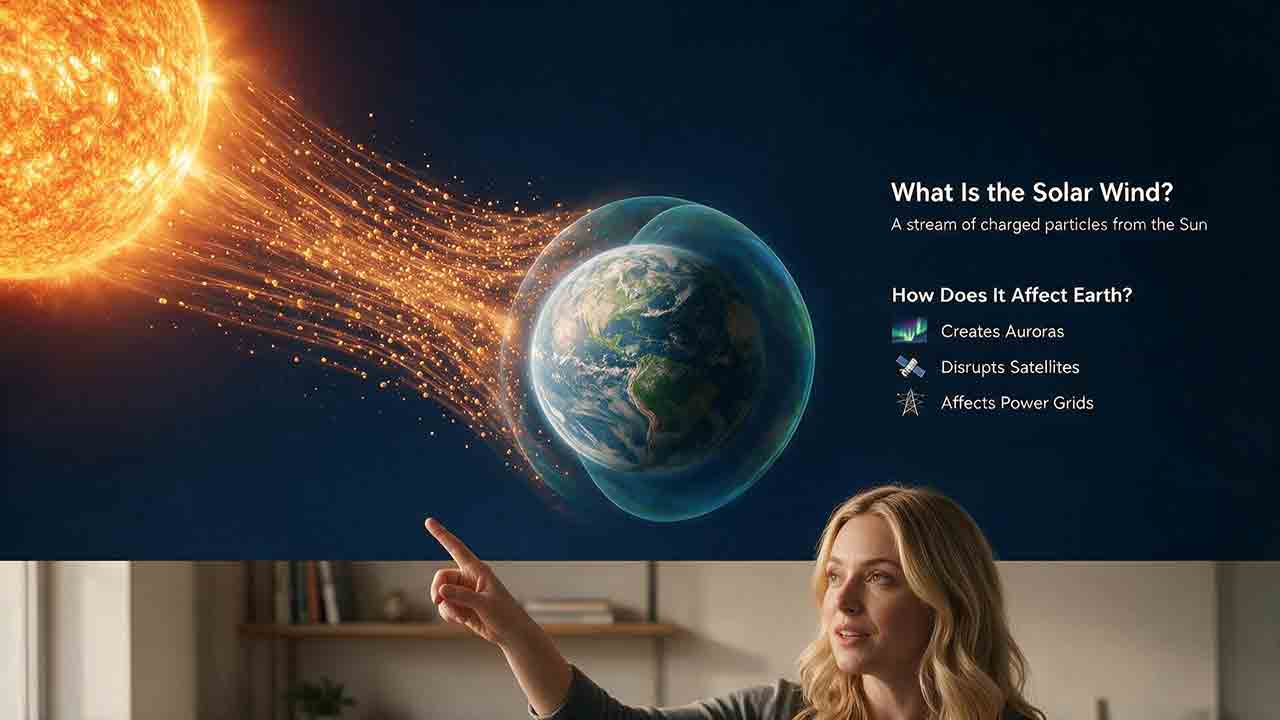
What Is the Solar Wind and How Does It Affect Earth?
The solar wind is a continuous stream of plasma and embedded magnetic fields flowing outward from the Sun. This article explains how that flow interacts with Earth’s magnetosphere and why solar-wind speed alone cannot predict the strength of a geomagnetic disturbance. Readers learn how proton density, dynamic pressure, magnetic-field strength, and southward Bz influence energy transfer into near-Earth space. The guide also distinguishes the solar wind from solar flares, coronal mass ejections, and solar energetic particles. Transparent travel-time and pressure calculations show how common measurements can be interpreted, while a practical decision framework explains how to read real-time NOAA data. The article also examines auroras, satellite drag, GPS accuracy, radio communication, power-grid effects, and the protection provided by Earth’s atmosphere and magnetic field. It emphasizes forecasting limits, data-quality checks, local viewing conditions, and the importance of relying on official space-weather alerts.
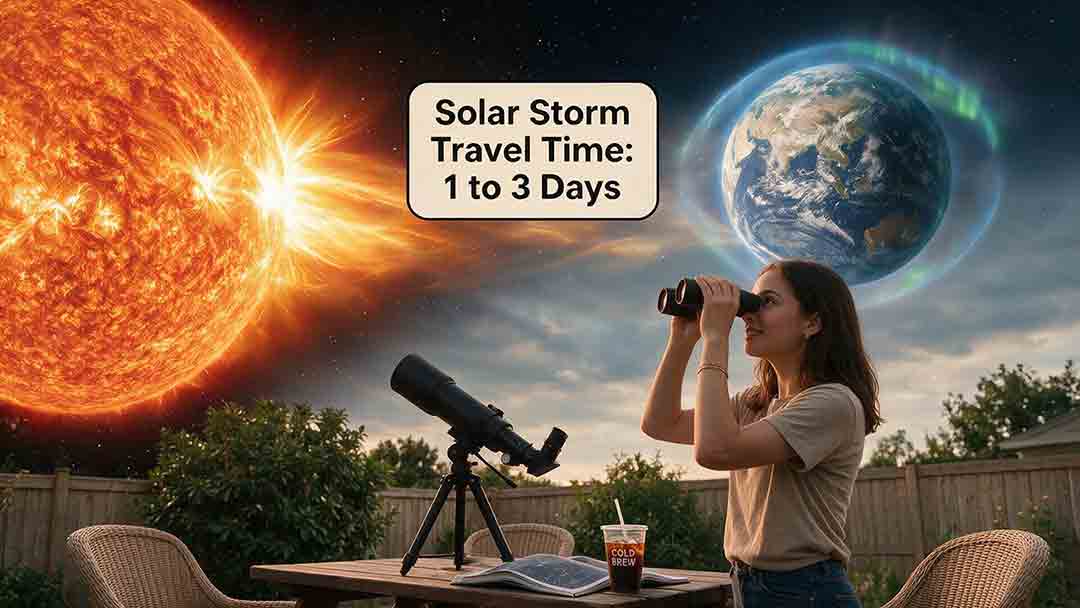
How Long Does a Solar Storm Take to Reach Earth?
A solar storm does not reach Earth on a single timetable because its radiation, energetic particles, and plasma travel at very different speeds. Solar-flare radiation arrives in about 8 minutes 20 seconds, while the fastest solar energetic particles can arrive in tens of minutes or less. An Earth-directed coronal mass ejection, or CME, generally takes one to several days, although exceptional events may arrive in roughly 15–18 hours. This guide introduces the Three-Clock, Two-Window Method for separating these timelines and understanding the difference between an early model forecast and short-term confirmation from spacecraft near the Sun–Earth L1 region. It also provides a transparent constant-speed calculation, real-world CME examples, common timing mistakes, and a practical process for interpreting official space-weather reports. Readers will learn why CME speed alone cannot determine arrival time, geomagnetic-storm strength, or whether aurora will be visible from a specific location.
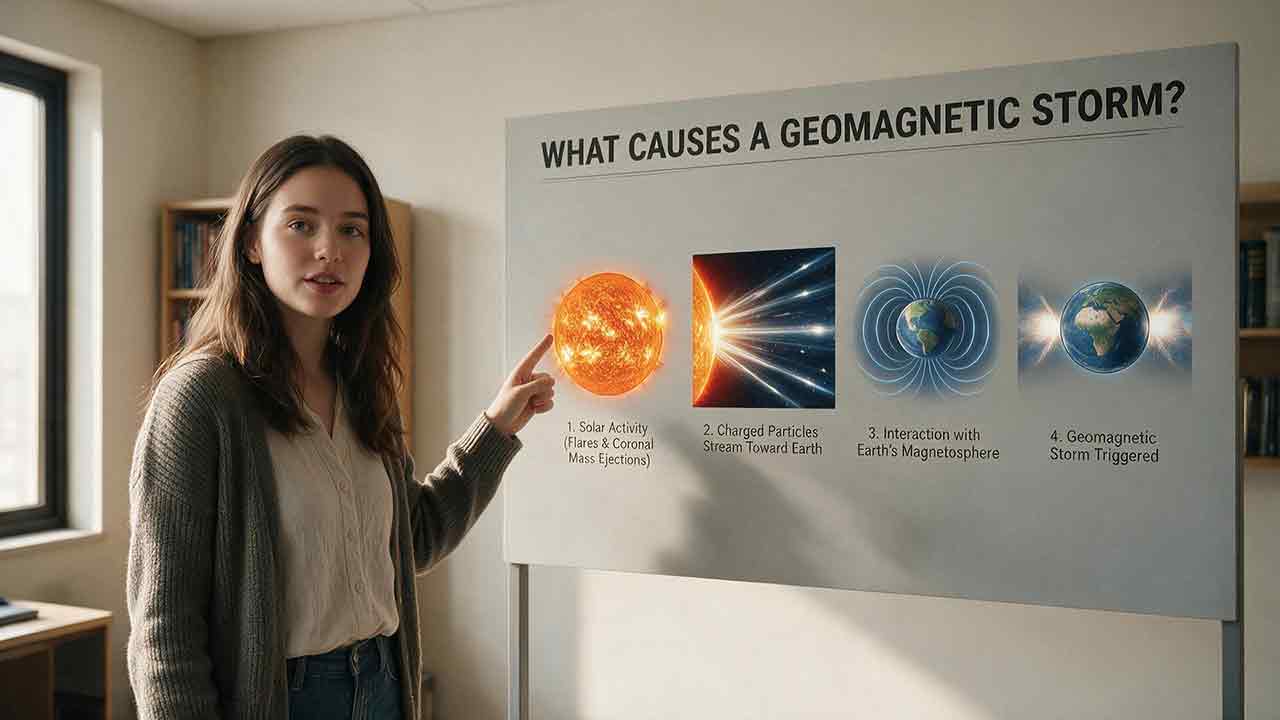
What Causes a Geomagnetic Storm?
A geomagnetic storm develops when a magnetized disturbance in the solar wind reaches Earth and transfers substantial energy into the magnetosphere. This guide explains the two main source pathways: Earth-directed coronal mass ejections, including their shocks and sheath regions, and high-speed solar-wind streams produced by coronal holes and co-rotating interaction regions. It shows why sustained southward Bz is often more important than solar-wind speed or flare class alone, and how magnetic reconnection intensifies currents and particle activity around Earth. The article also introduces a practical Four-Question Storm Potential Test, a transparent coupling calculation, a storm-potential matrix, and a forecast-reading checklist. Readers will learn how Kp, Dst, and local magnetic changes describe different parts of a storm, why forecasts remain uncertain, and how geomagnetic activity may affect auroras, satellites, navigation, radio communication, atmospheric drag, and grounded long-conductor systems.
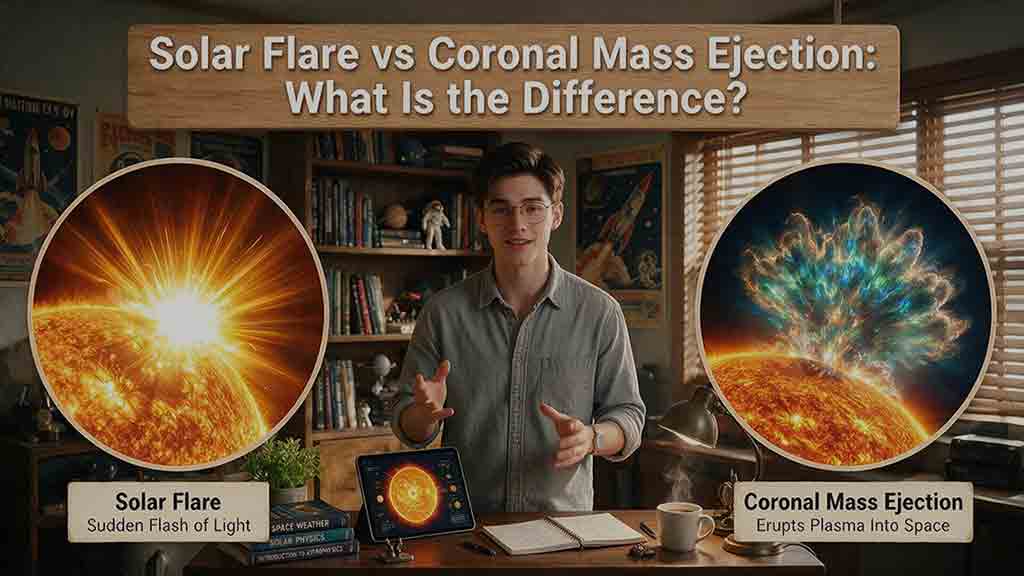
Solar Flare vs Coronal Mass Ejection: What Is the Difference?
A solar flare and a coronal mass ejection are related solar events, but they are not the same phenomenon. A solar flare is a rapid burst of electromagnetic radiation that can affect Earth’s sunlit ionosphere within about eight minutes, sometimes disrupting high-frequency radio communication. A coronal mass ejection, or CME, is a large cloud of magnetized plasma that usually takes many hours or several days to reach Earth. If it is Earth-directed and carries favorable magnetic conditions, a CME may trigger a geomagnetic storm, expand auroral visibility, increase satellite drag, and affect navigation or power systems. This guide compares their composition, speed, arrival time, NOAA alert scales, and potential effects. It also introduces the Flash–Cloud–Compass framework, practical checklists, travel-time examples, and troubleshooting guidance to help readers interpret flare reports, CME forecasts, Bz measurements, Kp values, and aurora alerts without confusing one type of space-weather event with another.
What Is Space Weather?
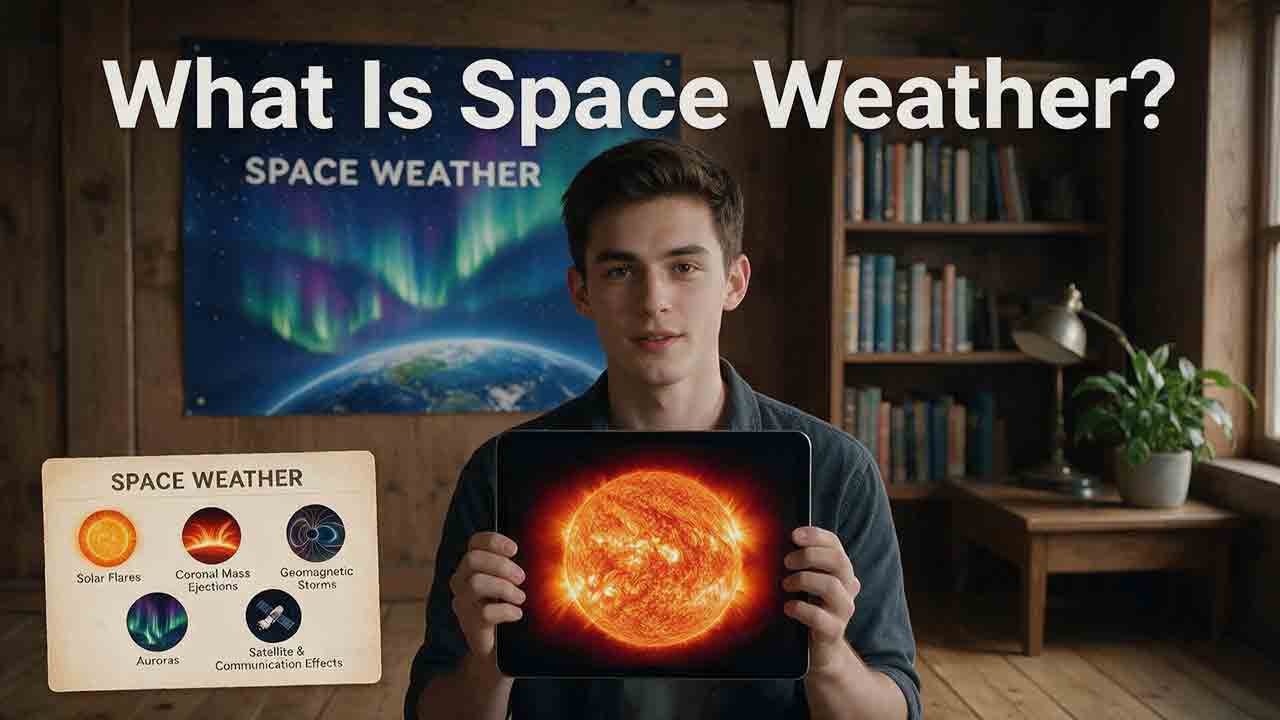
Space weather describes changing conditions in near-Earth space caused mainly by solar radiation, charged particles, the solar wind, and magnetic eruptions from the Sun. This guide explains how solar flares, coronal mass ejections, solar radiation storms, radio blackouts, and geomagnetic storms differ—and why they do not affect Earth in the same way. Readers will learn how NOAA’s G, S, and R scales work, what the Kp index and Bz component indicate, and how space weather can influence satellites, GPS and other navigation systems, radio communication, aviation, power grids, astronauts, and aurora visibility. The article also introduces an original Five-Link Space Weather Chain, a practical risk-assessment framework, a step-by-step method for reading forecasts, and a documented case study of the May 2024 geomagnetic storm. It uses authoritative information from NOAA, NASA, USGS, and ESA while clearly separating official definitions from editorial interpretation.