Technology & Infrastructure Impacts
Explore 5 fascinating articles about technology & infrastructure impacts
Understand how solar storms affect satellites, power grids, GPS, and communication networks on Earth and in orbit.
All Articles (5)
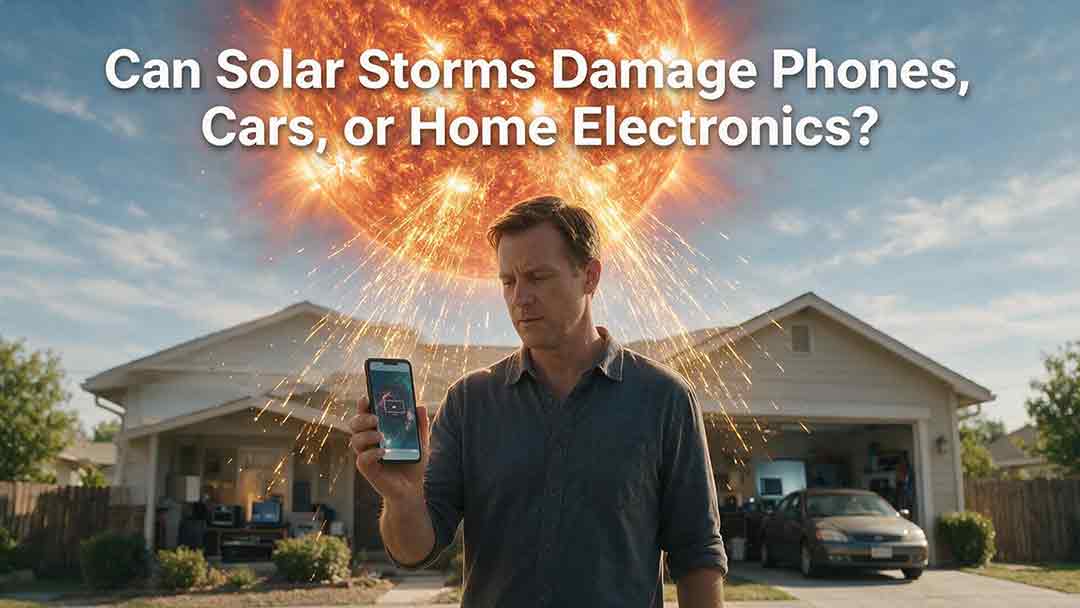
Can Solar Storms Damage Phones, Cars, or Home Electronics?
Solar storms are unlikely to directly destroy phones, disable passenger cars, or fry unplugged home electronics at ground level. The more realistic risks are indirect: degraded GPS accuracy, interrupted satellite or cellular services, power-grid disturbances, unavailable EV chargers, fuel-pump outages, and ordinary electrical problems during power restoration. This article explains why long, grounded infrastructure is more vulnerable to geomagnetically induced currents than compact consumer devices. It also separates solar flares, radiation storms, coronal mass ejections, and geomagnetic storms so readers can understand which technology effects belong to each event. Using the original Scale–Path–Dependency–Recovery framework, risk matrices, a May 2024 storm case study, troubleshooting guidance, and user-specific preparation advice, the guide helps households evaluate realistic exposure without fear-based claims. It also covers surge-protection limits, medical-equipment planning, offline navigation, EV charging, and safe outage preparation based on authoritative NOAA, NASA, USGS, NIST, Department of Energy, and Ready.gov guidance.
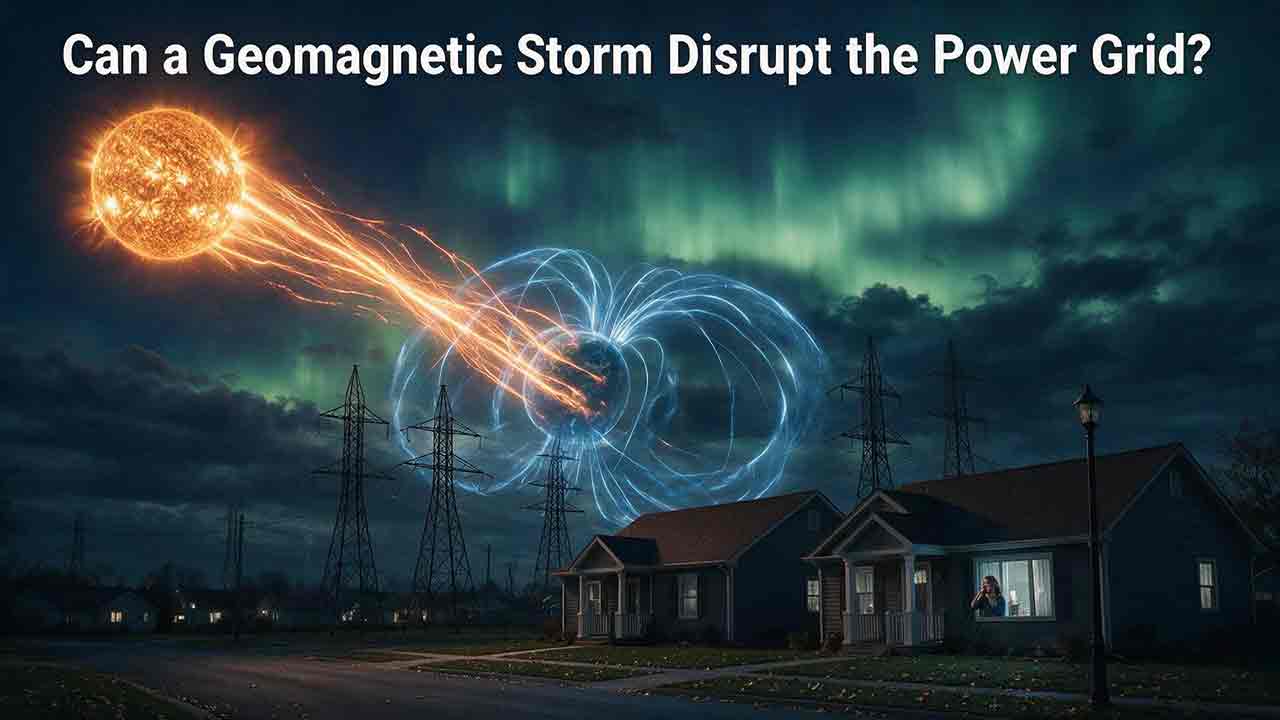
Can a Geomagnetic Storm Disrupt the Power Grid?
A geomagnetic storm can disrupt the power grid by creating geoelectric fields that drive geomagnetically induced currents through long, grounded transmission networks. This article explains how those currents can push transformers into part-cycle saturation, increase reactive-power demand, produce harmonics, trigger protective equipment, and—under severe conditions—contribute to voltage instability or a regional blackout. It also shows why a NOAA G5 rating does not automatically predict a local power failure. Using an original Four-Gate Grid Disruption Framework, a simplified voltage calculation, and a balanced comparison of the March 1989 Québec blackout and the May 2024 Gannon Storm, the guide examines how geology, line orientation, transformer design, system loading, and operator preparation shape the outcome. Readers will also find practical outage-preparation guidance for households, medical-device users, businesses, solar-and-battery owners, and critical facilities, supported by authoritative NOAA, USGS, NERC, DOE, Hydro-Québec, and Ready.gov sources.
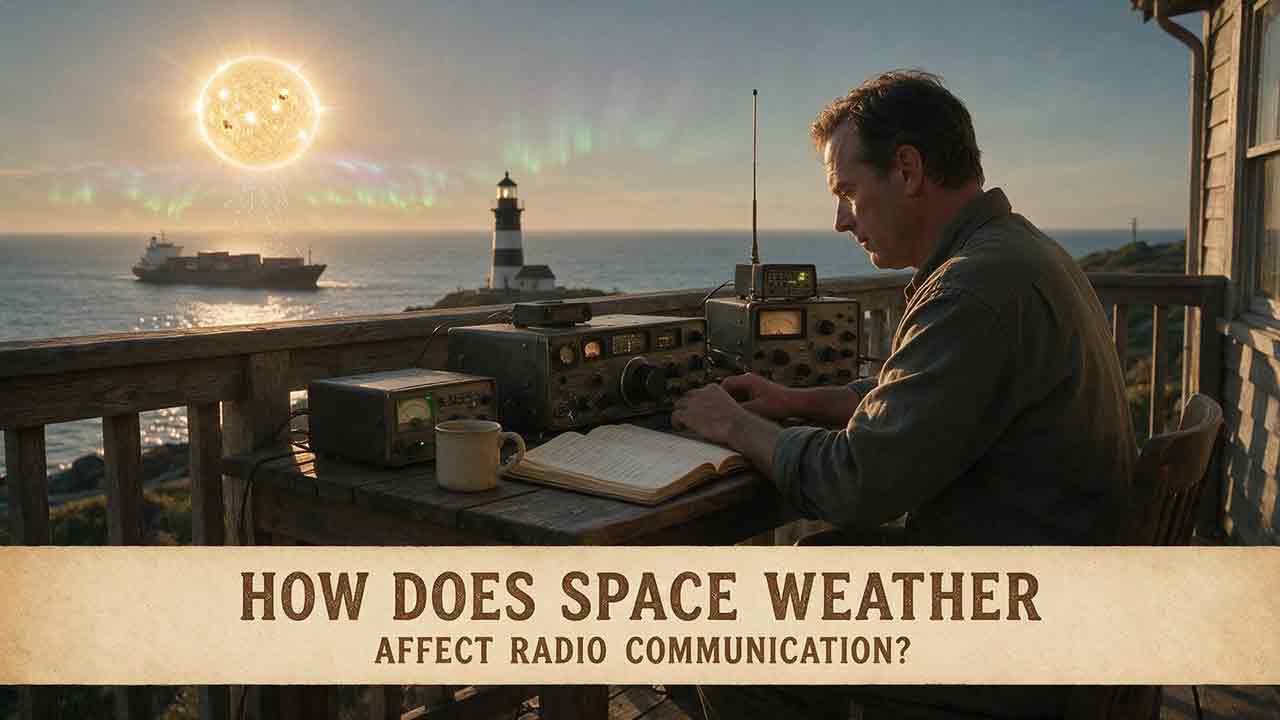
How Does Space Weather Affect Radio Communication?
Space weather can disrupt radio communication by changing the ionosphere, the electrically charged region used by long-distance HF radio and crossed by satellite signals. This article explains how solar flares can cause almost immediate HF radio blackouts on Earth’s sunlit side, how energetic particles can weaken polar communication routes, and how geomagnetic storms can alter usable frequencies and propagation paths. It also examines ionospheric scintillation, satellite signal fading, GNSS errors, and solar radio noise. Readers will learn how to distinguish space-weather effects from antenna faults, local interference, power problems, and network outages. The article introduces the EPBS Radio Impact Check—Event, Path, Band, and Symptom—as a practical diagnostic framework, supported by a documented NOAA R3 event, a link-margin calculation, troubleshooting tables, and mitigation options. It emphasizes that forecasts describe environmental conditions rather than guaranteeing failure on any individual radio link.
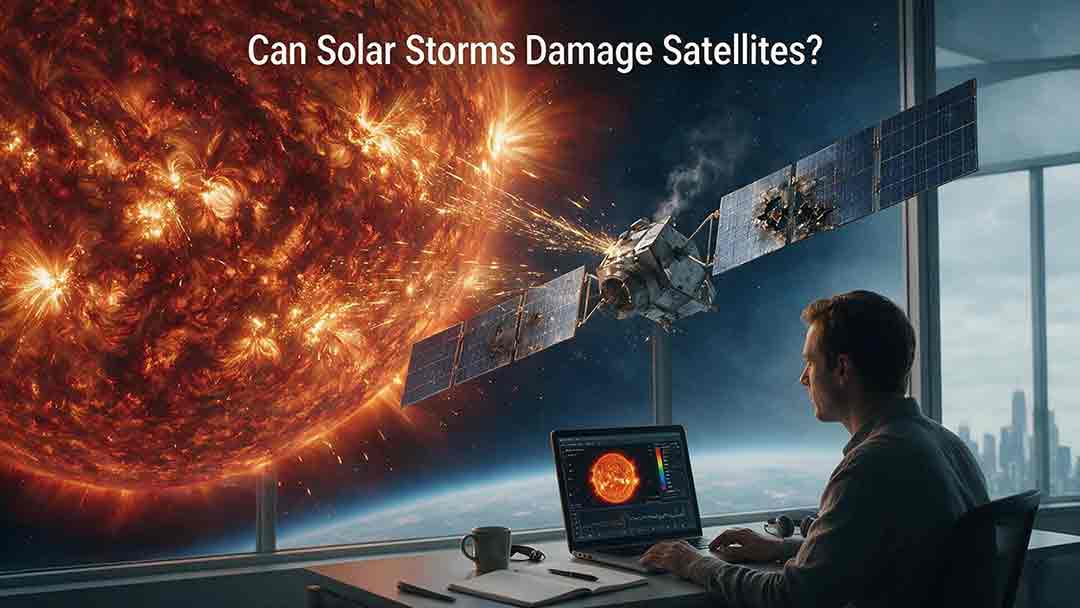
Can Solar Storms Damage Satellites?
Solar storms can disrupt satellites and, under unfavorable conditions, cause permanent hardware damage or mission loss. This article explains how energetic particles can upset electronics, how surface and internal charging may trigger electrical discharges, and why geomagnetic storms increase atmospheric drag on satellites in low Earth orbit. It also compares risks across low, medium, geostationary, polar, and deep-space orbits. Using the February 2022 Starlink losses as a documented example, the guide shows why orbit, spacecraft design, mission phase, storm duration, and recovery capability matter more than a storm rating alone. Readers will also find an illustrative drag calculation, an orbit-based risk table, the original ORBIT comparison framework, a pre-storm readiness checklist, and a practical anomaly-investigation process. The article draws on NASA, NOAA, ESA, and peer-reviewed sources while clearly distinguishing general education from mission-specific engineering advice.
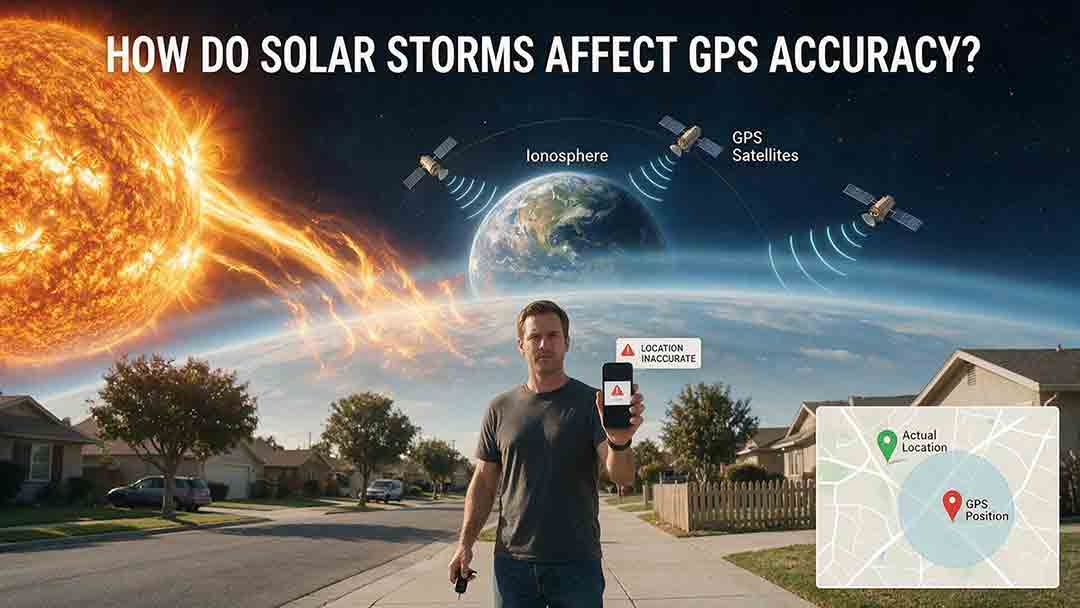
How Do Solar Storms Affect GPS Accuracy?
Solar storms can reduce GPS accuracy by disturbing the ionosphere, the electrically charged region through which satellite-navigation signals travel. This article explains how changing electron density can delay GPS signals, weaken correction models, disrupt carrier-phase tracking, and cause temporary loss of satellite lock. It compares the risks faced by single-frequency, dual-frequency, RTK, PPP, WAAS, multi-constellation, and GPS timing systems. A worked calculation shows how total electron content affects first-order GPS L1 path delay while clearly distinguishing signal-path delay from final position error. The article also examines the May 2024 WAAS service disruption, explains why Kp cannot predict local GPS error, and provides a practical risk-assessment framework, troubleshooting table, readiness checklist, and guidance for positioning and timing users. Official sources include NOAA, GPS.gov, the FAA, NASA, ESA-supported technical references, and the U.S. Coast Guard.