Can Solar Storms Damage Phones, Cars, or Home Electronics?

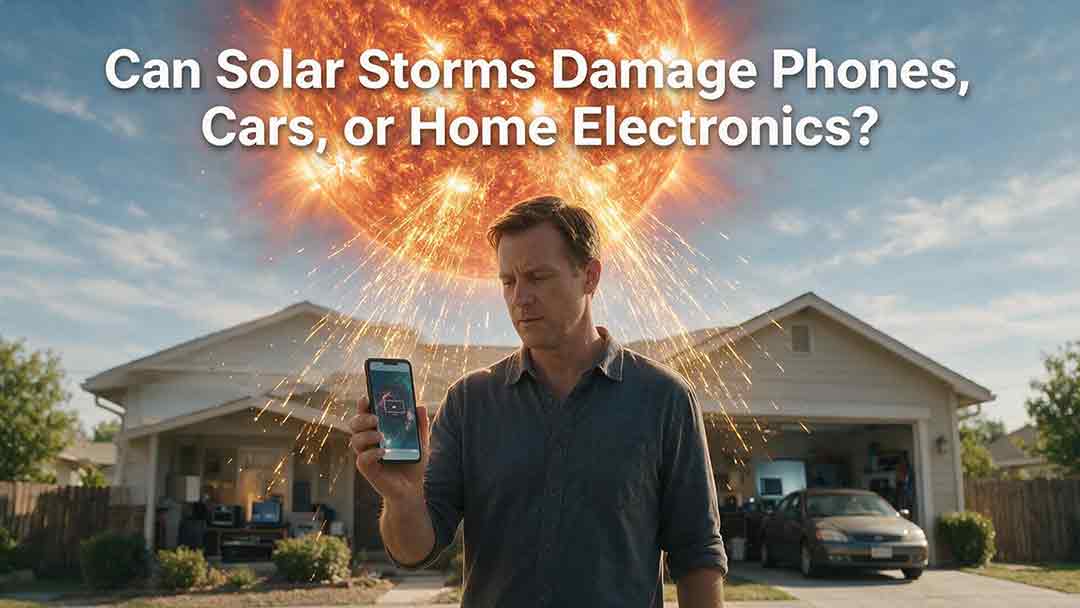
Can Solar Storms Damage Phones, Cars, or Home Electronics?
Solar storms are unlikely to directly fry a phone, disable a car, or destroy an unplugged household device at ground level. The more realistic risks are indirect: inaccurate GPS, interrupted satellite or cellular services, power-grid disturbances, charging problems, and ordinary electrical issues during an outage or recovery. Long, grounded infrastructure is generally more exposed than compact consumer electronics.
Key Takeaways
- Phones, cars, and household devices are unlikely to suffer direct hardware damage from an ordinary geomagnetic storm.
- GPS, radio, satellite services, cellular networks, traffic systems, fuel pumps, and EV chargers may become less reliable.
- Large, grounded conductors such as power-transmission lines face a different risk from small battery-powered electronics.
- Home electronics are more exposed to local power-quality problems than to solar particles arriving directly from space.
- Preparing for a conventional power or communications outage is more useful than buying fear-based “solar storm protection” products.
This guide helps readers separate documented space-weather effects from plausible indirect problems and unsupported disaster claims. It also provides a practical framework for deciding what, if anything, to do when a serious warning is issued.
Can Solar Storms Damage Electronics Directly?
For most consumer devices at ground level, direct damage is unlikely.
Earth’s atmosphere and magnetic environment shield the surface from much of the energetic-particle exposure that threatens spacecraft. Geomagnetic disturbances can still generate electric fields at Earth’s surface, but the largest currents tend to develop in long, conductive systems that provide an extended path through or along the ground.
That is why official risk assessments focus heavily on systems such as:
- high-voltage transmission networks;
- pipelines;
- long communication links;
- rail and signaling infrastructure;
- satellites and spacecraft;
- high-precision navigation services.
A smartphone, vehicle control unit, or unplugged laptop is much smaller and does not provide the same type of long, grounded path.
The most useful distinction is therefore:
A solar storm is more likely to disrupt the infrastructure a consumer device depends on than to destroy the device itself.
A phone may lose an accurate position while its processor and battery remain healthy. A car may lose live traffic information while its steering and drivetrain continue operating. A television may turn off because the neighborhood has lost power, not because solar radiation struck the television.
No credible article can promise that every device would survive every conceivable future event. However, reports from NOAA’s Space Weather Prediction Center, NASA heliophysics research, and USGS geoelectric-hazard studies do not support claims that ordinary solar storms routinely fry phones, stop passenger vehicles, or destroy household electronics directly.
Which Kind of Solar Activity Causes Each Problem?
“Solar storm” is an informal label that can refer to several different events. Treating them as interchangeable leads to misleading conclusions.
| Space-weather event | Plain-language definition | Main technology concern | What an ordinary user may notice |
|---|---|---|---|
| Solar flare | A sudden release of electromagnetic radiation from an active region on the Sun | HF radio blackouts and possible navigation-signal degradation on Earth’s sunlit side | Radio or positioning problems, not a phone being scorched by sunlight |
| Solar radiation storm | An increase in energetic protons and other charged particles | Astronaut exposure, spacecraft electronics, satellite operations, and some polar aviation concerns | Possible disruption of services that depend on affected satellites |
| Coronal mass ejection | A large cloud of plasma and magnetic field expelled from the Sun | May produce a geomagnetic storm if it reaches Earth with an effective magnetic orientation | Effects can begin later than the original eruption |
| Geomagnetic storm | A major disturbance of Earth’s magnetic environment | Power grids, pipelines, spacecraft, radio propagation, and satellite navigation | Possible power, GPS, communications, or satellite-service interruptions |
NOAA uses three different scales:
- G1–G5 for geomagnetic storms;
- R1–R5 for radio blackouts;
- S1–S5 for solar radiation storms.
A strong flare does not automatically mean that Earth will experience an extreme geomagnetic storm. A coronal mass ejection must be directed toward Earth, arrive at Earth, and carry magnetic conditions capable of coupling effectively with Earth’s magnetic field.
This matters because an “X-class flare” headline alone does not tell a homeowner whether the local power grid, a GPS receiver, or a household appliance will experience a problem.
Why Are Long Power Lines More Vulnerable Than Small Devices?
Geomagnetic storms can change Earth’s magnetic field over time. Those changes can generate electric fields at the surface.
When a conductor extends across a large geographic distance, a voltage can develop along it. If the system is grounded and provides a complete path, current may flow through equipment that was not designed to carry substantial quasi-direct current.
The severity of this effect depends on several variables:
- how quickly the magnetic field changes;
- the intensity and duration of the disturbance;
- the length and orientation of the conductor;
- the grounding arrangement;
- local and regional geology;
- the design of the affected infrastructure;
- the geographic location of the system.
The ground is not electrically uniform. USGS geoelectric-hazard research explains that electrically resistive geological structures can produce stronger surface electric fields than more conductive ground under comparable geomagnetic conditions.
This is why two regions experiencing the same broad storm may not experience the same grid effects.
A battery-powered phone has neither the geographic scale nor the grounding arrangement of a transmission line. An unplugged laptop is similarly isolated from long external conductors.
A plugged-in appliance is connected to a larger electrical network, but the disturbance must pass through multiple layers of generation, transmission, distribution, building wiring, and device power electronics before reaching it.
Utility controls, distribution equipment, building wiring, device power supplies, and properly installed protection may interrupt or reduce some disturbances, but none guarantees that every voltage event will be blocked. For households, the more realistic concerns remain loss of power, unstable local supply, and ordinary restoration-related electrical problems.
What Is the Solar-to-Device Impact Chain?
The following impact chain provides a more accurate way to think about consumer risk:
Solar eruption
→ disturbance in near-Earth space or the ionosphere
→ effect on a satellite, navigation signal, communication network, or power system
→ loss or degradation of a service
→ consumer inconvenience, interruption, or secondary equipment problem
The much less common consumer narrative would be:
Solar eruption
→ direct destruction of a compact ground-level device
The first chain is supported by well-established physical mechanisms and documented events. The second is frequently asserted online without evidence connecting ordinary consumer-device failures to geomagnetic induction.
This distinction is central to evaluating phones, vehicles, chargers, routers, appliances, and other electronics.
How Can Solar Storms Affect Phones?
A solar storm is unlikely to damage a phone’s processor, memory, camera, display, or battery directly. The phone may still become less useful when the services surrounding it are degraded.
Can a Solar Storm Make Phone GPS Inaccurate?
Yes. GPS and other Global Navigation Satellite System signals travel through the ionosphere before reaching a phone.
Geomagnetic disturbances can change the ionosphere’s electron density and structure. That can delay, bend, scatter, or destabilize satellite-navigation signals.
A consumer phone may show:
- a location marker that moves while the user is stationary;
- delayed route recalculation;
- an incorrect direction or speed;
- inconsistent positions between applications;
- difficulty establishing an accurate satellite fix;
- reduced accuracy in areas already affected by buildings, terrain, or weak signal geometry.
A road-navigation application may remain usable despite modest errors. Precision agriculture, surveying, construction, offshore operations, and aviation require far greater accuracy and integrity.
A phone displaying coordinates should therefore not be treated as proof that those coordinates are reliable enough for a safety-critical or precision task.
Can Cellular Service Be Interrupted?
Possibly, but the likely mechanism is indirect.
A cellular network depends on more than the user’s phone. It may rely on:
- utility power;
- backup batteries or generators;
- fiber or microwave backhaul;
- network timing;
- data centers;
- internet routing;
- cloud services;
- emergency-alert infrastructure.
A regional power or communications problem could result in:
- weaker coverage;
- temporary tower outages;
- slower mobile data;
- dropped calls;
- delayed messages;
- network congestion;
- difficulty accessing cloud-based applications.
Some towers have backup power, but backup duration, maintenance, fuel availability, and network design vary.
A working phone does not guarantee that every part of the network serving it will remain available.
Are Satellite-to-Phone Services More Exposed?
They can be.
Direct-to-device satellite services depend on spacecraft, ground stations, orbital tracking, radio links, and the state of the ionosphere. Space weather can affect satellite orientation, onboard electronics, atmospheric drag, uplinks, downlinks, and signal propagation.
The phone itself may remain undamaged while the satellite feature becomes delayed or temporarily unavailable.
Users should not assume that a satellite-enabled phone creates complete independence from power, network, weather, or space-weather conditions.
Can Solar Activity Drain a Phone Battery?
A solar storm does not normally pull energy directly from a phone battery.
Battery life may fall faster if the phone:
- repeatedly searches for a weak cellular signal;
- attempts to reconnect to a failed network;
- keeps navigation applications active;
- increases display use during an outage;
- is used as a hotspot for other devices;
- repeatedly attempts a satellite connection.
That is an operational consequence of poor connectivity or heavier use, not evidence that solar radiation has damaged the battery.
Can Solar Storms Damage or Disable Cars?
A geomagnetic storm is not expected to disable an ordinary passenger vehicle merely because the vehicle contains computers.
Modern vehicles contain many electronic modules, sensors, wiring harnesses, control networks, and power-conversion components. However, a vehicle is still a compact system compared with a regional power network or another long, grounded conductor.
Official accounts of major modern geomagnetic storms do not show a pattern of widespread passenger vehicles being directly disabled by geomagnetically induced currents.
The more credible risks involve external dependencies.
Which Vehicle Functions Could Be Affected?
The risk levels below are qualitative editorial assessments of plausible impact pathways. They are not measured probabilities, equipment certifications, insurance classifications, or predictions for a specific vehicle.
| Vehicle function or service | Direct hardware-damage risk | More plausible indirect issue |
|---|---|---|
| Engine or electric-drive controls | Very low | An ordinary electrical or mechanical fault unrelated to space weather |
| Built-in GPS navigation | Very low | Position error or temporary loss of a reliable satellite fix |
| Live traffic and cloud routing | Very low | Cellular, internet, server, or data-provider interruption |
| Satellite radio | Very low | Satellite-service or radio-propagation interruption |
| Automatic emergency-call service | Very low | Loss of cellular or satellite connectivity |
| EV traction battery | Very low | Inability to recharge during a prolonged outage |
| Public EV charger | Low | Utility outage, network failure, payment interruption, or charger unavailability |
| Fuel availability | Not applicable | Gas-station pumps or payment systems may be unavailable |
| Traffic signals | Not applicable | Signals may lose power or enter backup operation |
| Electronic tolling | Very low | Communication, account, or payment-service disruption |
“Very low” does not mean impossible under every imaginable circumstance. It means direct solar-storm damage is not the leading or best-supported failure pathway.
Are Electric Vehicles More Vulnerable?
An electric vehicle contains a large battery and high-power electronics, but battery size does not automatically make the vehicle an efficient collector of geomagnetically induced current.
The more practical concern is access to charging.
A charging station may depend on:
- grid power;
- a local transformer;
- cellular or wired internet;
- payment authorization;
- an operator’s cloud platform;
- remote maintenance services;
- account authentication.
A station may therefore be physically intact but unavailable because one dependency has failed.
For EV owners, proportionate preparation includes:
- Avoid allowing the vehicle to remain near an empty state of charge when a serious regional outage is possible.
- Download offline maps showing alternative charging locations.
- Know whether nearby chargers require a working application, account, or cellular connection.
- Confirm which circuits a home backup system can support.
- Do not assume that rooftop solar can charge the vehicle while the grid is down.
- Follow the vehicle and charger manufacturers’ instructions after an outage.
A malfunctioning charger should not be opened, rewired, bypassed, or repeatedly reset by an unqualified user.
Can Fuel-Powered Cars Also Be Affected?
Yes, indirectly.
Gasoline and diesel vehicles depend on fuel stations whose pumps, lighting, payment terminals, monitoring equipment, and communications usually require electricity.
Road travel can also be affected by:
- failed traffic signals;
- closed tunnels or bridges;
- disrupted tolling;
- unavailable live traffic information;
- inaccurate navigation;
- emergency-service congestion.
This is why “my car still starts” and “I can travel normally” are not always the same conclusion.
Can Solar Storms Damage Home Electronics?
Direct solar-storm damage to compact household electronics is unlikely. The greater concern is how those devices respond to a local power interruption or power-quality disturbance.
A television, refrigerator, desktop computer, modem, or smart-home hub could:
- turn off during an outage;
- reboot during a voltage dip;
- lose unsaved data;
- fail to reconnect after power returns;
- encounter an ordinary electrical transient;
- remain offline because the internet provider is unavailable.
These outcomes can occur during storms, accidents, equipment failures, wildfires, heat waves, maintenance, and many other grid events. Their occurrence during a geomagnetic storm does not by itself prove that space weather directly damaged the device.
How Does Connection Type Change the Risk?
The following ratings are qualitative assessments, not measured failure probabilities.
| Device condition | Direct solar-storm risk | More realistic indirect risk | Practical response |
|---|---|---|---|
| Battery-powered and unplugged | Very low | Loss of network service or future charging access | Keep it charged and store it normally |
| Plugged into a wall outlet | Very low | Outage, voltage instability, or abrupt shutdown | Use appropriate electrical protection and follow utility guidance |
| Connected to coax, Ethernet, or an outdoor antenna | Low | Additional external conductive paths or provider failure | Use properly installed protection where appropriate |
| Connected through a UPS | Very low | Limited runtime followed by shutdown | Save work and shut down before the battery is depleted |
| Connected to a standby generator | Very low | Transfer, fuel, installation, or power-quality problems | Follow the installer’s and manufacturer’s procedures |
| Connected to rooftop solar | Very low | Inverter shutdown or loss of grid connection | Know whether the system includes approved backup operation |
| Essential medical equipment | Very low direct risk | Serious consequences if power or communications fail | Maintain a device-specific emergency power and assistance plan |
Do Surge Protectors Help?
A properly selected surge-protection system can reduce damage from many common electrical surges and transients.
However, a surge protector should not be described as a guaranteed “solar storm shield.”
NIST residential surge guidance emphasizes that electrical protection should account for the different paths through which disturbances may enter a property.
Important limitations include:
- A surge protector does not provide backup electricity.
- A plug-in strip cannot guarantee protection against every electrical event.
- Protection components may degrade over time.
- Power, data, telephone, coaxial, and antenna connections may require different protection.
- A circuit breaker is not a substitute for surge protection.
- Whole-building devices require correct selection and installation.
- Service-panel work should be performed by a qualified professional.
General surge protection may be a sensible part of ordinary electrical safety. It should not be purchased because a seller claims that one product can guarantee protection from geomagnetic storms, nuclear EMP, lightning, blackouts, and every other electrical threat.
Should You Unplug Electronics?
For routine minor or moderate geomagnetic activity, unplugging every device in a home is generally unnecessary.
During a severe event, follow instructions from the electric utility, emergency-management authorities, and national warning services. Ready.gov’s space-weather guidance advises disconnecting appliances when local officials instruct residents to do so.
Temporarily disconnecting nonessential sensitive equipment may also be reasonable when:
- the utility has warned of unstable conditions;
- the power is cycling on and off;
- lights repeatedly dim or flicker;
- an outage has begun;
- a UPS is nearly depleted;
- local authorities recommend reducing electrical demand.
Do not disconnect equipment when doing so would create a greater immediate danger. Essential medical, fire-safety, security, pumping, heating, and ventilation systems may require a planned backup rather than an improvised shutdown.
How Should Risk Be Judged?
The Scale–Path–Dependency–Recovery Framework offers a practical way to judge the risk to any device.
1. Scale: Is the Conductive System Large Enough to Matter?
Long transmission lines and pipelines span large geographic distances and may develop significant storm-related voltages.
Small battery-powered devices do not have the same scale.
Ask:
- Is this a handheld or household device?
- Is it part of a regional network?
- Does it include long external wiring?
- Is it grounded at distant points?
2. Path: How Is the Device Connected?
An unplugged radio has fewer external paths than a home theater connected to utility power, Ethernet, coaxial cable, and an outdoor antenna.
More connections do not guarantee damage. They simply create more ways for a power or service disturbance to reach the equipment.
Ask:
- Is it plugged into utility power?
- Is it connected to an outdoor antenna?
- Does it use coaxial, telephone, or data cabling?
- Does it rely on a charger connected to the grid?
- Is it isolated on battery power?
3. Dependency: Which Outside Services Must Work?
Many apparent “device failures” are actually dependency failures.
A device may require:
- electricity;
- GPS or another satellite-navigation system;
- cellular service;
- internet backhaul;
- satellite communications;
- cloud authentication;
- payment processing;
- remote servers;
- accurate timing.
The more dependencies a device has, the more ways its usefulness can be reduced without any physical damage.
4. Recovery: What Must Happen After Service Returns?
An outage ending does not mean every service immediately returns to normal.
Possible recovery issues include:
- simultaneous appliance startup;
- depleted UPS batteries;
- router and modem resynchronization;
- delayed cellular restoration;
- charger-network authentication failures;
- smart devices losing settings;
- servers processing a backlog of requests;
- circuit or equipment faults unrelated to space weather.
For many households, the recovery phase may be more noticeable than the geomagnetic disturbance itself.
What Does the Evidence Actually Support?
A useful evidence ladder prevents well-supported risks from being mixed with speculation.
Level 1: Documented Effects
Official and scientific sources document effects involving:
- satellite operations;
- increased atmospheric drag on low-Earth-orbit spacecraft;
- energetic-particle exposure in space;
- HF radio propagation;
- ionospheric disturbances;
- satellite-navigation accuracy;
- geomagnetically induced currents in long grounded systems;
- power-system monitoring and mitigation.
Level 2: Plausible Consumer Consequences
These documented effects can lead to plausible household consequences such as:
- inaccurate phone or vehicle navigation;
- interrupted satellite features;
- unavailable mobile networks;
- power outages;
- unavailable EV chargers;
- fuel-station closures;
- disrupted payment systems;
- reduced internet access;
- inability to recharge devices.
Level 3: Claims That Require Stronger Evidence
Claims that phones will be “fried,” modern cars will stop nationwide, or every plugged-in appliance will be destroyed require evidence that is generally absent from official modern storm reports.
A video showing a failed device during an aurora is not enough to establish causation. The device may have failed because of:
- an ordinary battery problem;
- a local utility fault;
- a software issue;
- damaged wiring;
- weak GPS reception;
- unrelated severe weather;
- a provider outage.
Timing alone does not prove that space weather directly caused a hardware failure.
A Practical Consumer Risk Matrix
The ratings below are qualitative editorial assessments of the most plausible impact pathways. They are not measured probabilities, forecasts, insurance categories, equipment certifications, or promises about a specific household.
| Device or system | Direct physical-damage risk | Service or navigation risk | Grid-related risk | Practical concern |
|---|---|---|---|---|
| Unplugged smartphone | Very low | Moderate during a severe event | Charging may later become unavailable | Low |
| Plugged-in smartphone | Very low | Moderate | Depends on local power and charger conditions | Low |
| Battery-powered laptop | Very low | Moderate if networks fail | Limited by battery runtime | Low |
| Desktop computer | Very low | Moderate | Abrupt shutdown or unstable supply | Moderate |
| Home router | Very low | High dependency on power and provider infrastructure | Stops without backup power | Moderate |
| Refrigerator or freezer | Very low | Minimal | Food-storage concern during a prolonged outage | Moderate |
| Gasoline or diesel car | Very low | Low to moderate | Fuel pumps and traffic systems may be unavailable | Low to moderate |
| Electric vehicle | Very low | Low to moderate | Charging access may be interrupted | Moderate |
| Essential medical equipment | Very low | Varies by device | Consequences of power loss may be serious | High preparedness priority |
| High-voltage transformer | Meaningful during severe disturbances | Not applicable | Direct infrastructure exposure | High system-level concern |
| Satellite | Meaningful | High | Not dependent on household power | High operator concern |
The table does not mean that every “moderate” system will fail during a G5 event. It means that the identified pathway deserves more preparation than direct damage to a small, isolated device.
What Did the May 2024 Gannon Storm Show?
The May 10–12, 2024 Gannon storm provides a useful real-world test.
NOAA recorded G5, or Extreme, geomagnetic-storm conditions—the highest category on the NOAA G scale. NASA later described the event as the largest geomagnetic storm to reach Earth in approximately two decades.
The event produced documented technology effects without causing universal failure of consumer electronics.
High-Precision Navigation Was Disrupted
A study available through the NOAA Institutional Repository reported that the storm disrupted precision navigation used by farming equipment.
This does not mean every phone lost GPS. It shows that high-precision applications can become unreliable even when ordinary consumer navigation appears partly functional.
The distinction matters because agricultural guidance systems may require accuracy far beyond what is necessary to follow a road route.
A NASA Satellite Entered Safe Hold
NASA reported that increased atmospheric drag affected the ICESat-2 satellite during the storm. The spacecraft rotated unexpectedly and entered a protective safe-hold state.
NASA also reported that no detectable damage was found in the satellite or its instrument. The team adjusted the spacecraft’s orbit and returned it to science operations.
This is a valuable example of the difference between:
- an operational disturbance;
- a protective shutdown;
- temporary loss of service;
- permanent hardware destruction.
Temporary Radiation Belts Formed
NASA later reported that the storm created two temporary belts of energetic particles around Earth. Such particles matter to spacecraft because they can expose electronics and astronauts to hazardous radiation environments.
That finding does not imply that comparable particle exposure reached phones or household electronics on the ground.
Consumer Devices Did Not Fail Universally
Official reports focused on:
- spacecraft operations;
- increased atmospheric drag;
- high-precision navigation;
- power-grid monitoring;
- radio conditions;
- ionospheric and upper-atmospheric changes;
- widespread aurora.
They did not document a global pattern of phones being fried, passenger cars being electronically disabled, or household appliances being directly destroyed by solar particles.
The Gannon storm therefore supports a restrained conclusion: extreme space weather can create meaningful technical and infrastructure problems without producing the consumer-electronics apocalypse often predicted in sensational posts.
What Should You Do When a Severe Storm Is Forecast?
The most useful response is ordinary outage and communications preparation.
Step 1: Identify the Alert Type
Check whether the warning refers to:
- a geomagnetic storm on the G scale;
- a radio blackout on the R scale;
- a solar radiation storm on the S scale.
These alerts describe different hazards.
NOAA’s Space Weather Prediction Center is the official U.S. source for operational space-weather forecasts, watches, warnings, and alerts.
Step 2: Check the Severity and Location
The G scale runs from G1, Minor, to G5, Extreme.
The published scale descriptions summarize possible effects, not guaranteed outcomes for every location. Actual consequences depend on storm characteristics, latitude, geology, grid configuration, satellite design, and other conditions.
Do not use Kp alone as a household damage forecast.
Step 3: Prepare for a Normal Power Outage
Useful actions include:
- charging phones and approved power banks;
- charging mobility-device and medical-equipment batteries;
- downloading offline maps;
- keeping flashlights accessible;
- checking smoke and carbon-monoxide alarm batteries;
- maintaining a practical vehicle fuel level or EV charge;
- saving important local contact information;
- confirming how to open an electric garage door manually;
- checking the operating time of any UPS;
- reviewing food, water, and medication plans.
These actions are useful for many emergencies and do not depend on a solar storm causing a specific type of failure.
Step 4: Protect Important Data
Save active work and back up important files.
A UPS may provide enough time to shut down a computer or storage device safely. It should not be treated as unlimited backup power.
Users operating home servers, network storage, or workstations should understand:
- how long the UPS can support the load;
- whether automatic shutdown is configured;
- whether networking equipment is also protected;
- how the system should be restarted after power stabilizes.
Step 5: Download Navigation Alternatives
Before traveling:
- download the relevant map area;
- record the destination address;
- note major road names;
- identify alternative fuel or charging locations;
- avoid relying exclusively on live cloud routing.
Drivers should stop safely before attempting to diagnose an implausible navigation result.
A consumer offline map is not a replacement for approved navigation procedures in aviation, maritime, emergency-response, surveying, or other safety-critical work.
Step 6: Follow Local Instructions
A national alert cannot describe the exact condition of every utility network.
Follow instructions from:
- the local electric utility;
- emergency-management authorities;
- transportation agencies;
- equipment manufacturers;
- healthcare providers;
- charging-network operators.
Utility operators may take protective action that prevents or reduces customer disruption. The absence of visible household effects does not mean no operational response occurred.
Step 7: Reconnect Equipment Carefully
After an outage:
- Confirm that local authorities consider conditions safe.
- Check for damaged cords, outlets, water intrusion, or unusual odors.
- Restart essential systems first.
- Allow modems and routers time to reconnect.
- Reconnect nonessential loads gradually.
- Confirm that refrigerators, freezers, pumps, alarms, and medical devices are operating.
- Stop using equipment that overheats, smells burned, sparks, or repeatedly trips a breaker.
Do not open a service panel, modify wiring, or bypass protective equipment unless qualified and legally permitted to do so.
What Should Different Users Prioritize?
General Households
Focus on lighting, phone charging, food safety, offline information, and the ability to shut down computers cleanly.
There is little practical reason to dismantle electronics or place everyday devices in improvised metal containers.
Electric-Vehicle Owners
Maintain enough charge to reach essential destinations or an alternative charger.
Know whether:
- a charging station can operate without internet service;
- payment requires a mobile application;
- the station has backup power;
- a home battery can support the charger;
- rooftop solar can operate when disconnected from the grid.
Many grid-tied solar systems shut down during an outage unless approved backup and islanding equipment has been installed.
Rural and Remote Households
Prepare for potentially longer restoration times and fewer communications alternatives.
Useful priorities include:
- offline maps;
- backup charging;
- local radio;
- stored emergency numbers;
- a tested water plan;
- fuel or charge for essential travel;
- a safe backup plan for heating or cooling.
Precision-GNSS Users
Surveyors, farmers, construction teams, scientists, and other high-precision users should monitor notices from their receiver, correction-service, and equipment providers.
Pause operations when integrity cannot be confirmed. A receiver producing a coordinate is not necessarily producing a trustworthy coordinate.
People Using Essential Medical Equipment
Follow the equipment manufacturer’s backup-power instructions and maintain a written emergency plan.
The plan may include:
- the equipment’s expected battery duration;
- approved replacement batteries;
- utility medical-support registration where available;
- healthcare contact details;
- a relocation or assistance plan;
- transportation options;
- the location of an appropriate backup facility.
If essential equipment loses power or cannot operate as required, follow the device-specific emergency plan and seek immediate assistance through the appropriate healthcare, utility, or emergency channel rather than waiting for space-weather conditions to improve.
Do not improvise medical-device wiring, assemble an unapproved battery system, or operate a combustion generator indoors.
Home Solar and Battery Owners
Confirm which circuits the backup system actually supports.
Questions to ask the installer or manufacturer include:
- Can the system operate when the utility grid is down?
- Does it include approved islanding equipment?
- Can it start large motor loads?
- Can it support heating, cooling, pumps, or an EV charger?
- What happens when the battery reaches its minimum charge?
- How should the system be restarted after a prolonged outage?
Owning solar panels does not automatically mean a home will have power during a grid outage.
How Can You Troubleshoot a Problem During a Solar Storm?
| Symptom | Plausible explanations | Safe next step |
|---|---|---|
| Phone location jumps or drifts | Ionospheric disturbance, poor satellite geometry, buildings, terrain, or an ordinary receiver issue | Compare with road signs or another map; avoid precision decisions |
| Cellular signal disappears | Tower outage, congestion, backhaul failure, maintenance, or local terrain | Try text messaging, Wi-Fi calling, or another available network |
| Car navigation gives an implausible route | GNSS error, stale map data, cloud-service failure, or incorrect destination data | Stop safely and verify with an offline map |
| Satellite radio stops | Obstruction, provider outage, receiver fault, or satellite-link problem | Check the provider’s official status and retry later |
| Computer repeatedly reboots | Voltage instability, outage cycling, overheating, or a hardware fault | Shut it down and disconnect it if safe |
| Router has power but no internet | ISP failure, damaged local line, upstream outage, or modem synchronization delay | Check the provider’s status and allow time to reconnect |
| EV charger appears offline | Utility failure, network outage, payment problem, account issue, or charger fault | Use an alternative station and follow operator guidance |
| Lights repeatedly flicker | Local utility condition, loose wiring, overloaded circuit, or equipment problem | Reduce nonessential load and contact the utility or an electrician |
| A breaker repeatedly trips | Wiring or equipment fault | Stop resetting it and obtain qualified assistance |
| Medical equipment alarms after an outage | Low battery, failed power source, restart problem, or device fault | Follow the emergency plan and seek immediate assistance |
Space weather should not become the default explanation for every malfunction occurring during an aurora.
Common local causes remain more likely in many situations.
Which Common Reactions Are Unhelpful?
Treating a Geomagnetic Storm as a Nuclear EMP
A natural geomagnetic disturbance and a nuclear electromagnetic pulse involve different physical mechanisms, timescales, frequency characteristics, and equipment vulnerabilities.
Advice developed for one event should not automatically be transferred to the other.
Assuming Every X-Class Flare Threatens Household Electronics
The flare class describes measured X-ray output. It does not, by itself, predict a later geomagnetic storm or a consumer-device failure.
An associated coronal mass ejection may miss Earth, arrive only weakly, or carry an unfavorable magnetic orientation for producing a major storm.
Using Kp as a Device-Damage Meter
Kp measures broad planetary geomagnetic activity.
It is useful for describing storm conditions and estimating auroral visibility. It does not provide a percentage probability that a particular phone, vehicle, refrigerator, or television will fail.
Buying Universal “Solar Storm Protection”
Be cautious when a product claims guaranteed protection against all of the following:
- solar flares;
- geomagnetic storms;
- nuclear EMP;
- lightning;
- grid surges;
- blackouts;
- radio interference.
These hazards do not share one universal consumer solution.
A shielded phone bag cannot keep an EV charger online, restore a cellular tower, protect food in a refrigerator, or provide electricity to medical equipment.
Assuming a Surge Protector Is a Battery
A surge-protection device attempts to limit certain electrical transients.
A UPS or battery provides temporary stored energy.
A generator creates electricity from fuel.
These systems address different problems and have different installation, operating, and safety requirements.
Waiting for Proof of the Cause
During an outage or medical-equipment failure, the immediate problem matters more than proving whether the original trigger was space weather.
Follow the relevant emergency, utility, healthcare, or equipment procedure first. Cause analysis can come later.
Who Will Find This Guide Useful?
This guide is intended for:
- homeowners and renters;
- smartphone users;
- drivers;
- EV owners;
- remote workers;
- small-office operators;
- people planning for ordinary outages;
- readers trying to evaluate alarming solar-storm claims.
It is not an operating manual for:
- power-grid operators;
- satellite controllers;
- airlines;
- maritime operators;
- pipeline companies;
- telecommunications carriers;
- emergency-management agencies;
- safety-critical navigation users.
Those organizations require sector-specific forecasts, standards, engineering models, and operating procedures.
What Does This Article Not Claim?
This article does not claim that:
- every future solar storm will resemble past events;
- consumer devices have absolutely zero theoretical risk;
- every electric grid has the same vulnerability;
- every location will experience the same geoelectric field;
- surge protection guarantees that equipment cannot fail;
- a G5 alert predicts the outcome for one home;
- household preparations can protect national infrastructure;
- a reported malfunction was caused by space weather merely because it occurred during an alert.
The goal is to rank the best-supported risks, not to offer an absolute guarantee.
What Is the Most Practical Conclusion?
Solar storms can affect phones, cars, and home electronics, but direct destruction of compact consumer hardware is not the leading risk.
The most credible chain runs through infrastructure:
- disturbed ionosphere;
- degraded GPS;
- affected satellite operations;
- stressed power systems;
- interrupted communications;
- unavailable charging or fuel;
- ordinary outage and restart problems.
For most households, the right response is calm preparation:
- charge essential devices;
- download offline information;
- protect important data;
- maintain a reasonable vehicle fuel level or state of charge;
- understand backup-power limitations;
- follow official warnings;
- prepare for a conventional outage.
People who depend on medical equipment, precision navigation, remote communications, or EV charging should maintain more detailed continuity plans.
Routine users do not need to panic, dismantle vehicles, or store every electronic device in improvised shielding.
Frequently Asked Questions
Can a solar flare fry a smartphone?
A solar flare is very unlikely to fry a smartphone at ground level. Strong flares can disrupt HF radio and contribute to navigation problems, while related space weather may affect satellites and infrastructure. The phone may temporarily lose a service without suffering hardware damage.
Should I turn off my phone during a geomagnetic storm?
Turning off a phone is not normally necessary for hardware protection. Keeping it charged, downloading offline maps, and reducing unnecessary battery use may be helpful if electricity or network service becomes unreliable.
Can a solar storm stop a car while it is being driven?
Official modern storm reports do not show a pattern of ordinary passenger cars being directly stopped by geomagnetic storms. Inaccurate navigation, failed traffic signals, unavailable fuel pumps, or offline EV chargers are more plausible concerns.
Are electric vehicles more vulnerable than gasoline cars?
An EV’s traction battery and onboard electronics are not expected to be directly damaged merely because a geomagnetic storm is occurring. However, an EV depends on electricity and charging infrastructure, while a gasoline vehicle depends on electrically powered fuel pumps. Both can face indirect access problems.
Will unplugging appliances protect them?
Disconnecting a device isolates it from some external electrical paths, but unplugging an entire home is usually unnecessary during minor activity. Follow utility or emergency instructions during a severe event, and never disconnect essential equipment without a safe backup plan.
Can a solar storm destroy the entire internet?
A severe event could disrupt portions of the electrical, satellite, cable, and communications infrastructure on which internet service depends. Claims that one storm will permanently destroy the entire global internet oversimplify a distributed system built from many technologies, routes, operators, and levels of redundancy.
Sources
This guide is based on official space-weather guidance, government research, infrastructure documentation, and clearly stated qualitative risk criteria. It does not report laboratory testing of individual phones, vehicles, chargers, surge protectors, or household appliances.
- NOAA Space Weather Prediction Center — NOAA Space Weather Scales, accessed August 3, 2026.
- NOAA Space Weather Prediction Center — Official Forecasts, Watches, Warnings, and Alerts, accessed August 3, 2026.
- NASA Science — Solar Storms and Flares, accessed August 3, 2026.
- NASA Science — What NASA Is Learning from the Biggest Geomagnetic Storm in 20 Years, published May 9, 2025; accessed August 3, 2026.
- NASA Science — After Solar Storms, ICESat-2 Expected to Resume Operations in Mid-June, published June 11, 2024; accessed August 3, 2026.
- NASA Science — NASA CubeSat Finds New Radiation Belts After May 2024 Solar Storm, updated February 6, 2025; accessed August 3, 2026.
- NOAA Institutional Repository — GOLD Observations of the Thermospheric Response to the 10–12 May 2024 Gannon Superstorm, published 2024; accessed August 3, 2026.
- U.S. Geological Survey — Magnetic Storms and Geoelectric Hazards, published February 24, 2026; accessed August 3, 2026.
- U.S. Geological Survey — The Solar Cycle, Geology, and Geoelectric Hazards for Power Grids, revised October 16, 2024; accessed August 3, 2026.
- U.S. Department of Energy — Geomagnetic Disturbance Monitoring Approach and Implementation Strategies, accessed August 3, 2026.
- Ready.gov — Space Weather, updated March 5, 2026; accessed August 3, 2026.
- National Institute of Standards and Technology — Surges Happen! How to Protect the Appliances in Your Home, accessed August 3, 2026.
Editorial Approach
The article separates three categories that are frequently confused:
- documented effects on spacecraft and large infrastructure;
- plausible indirect consequences for consumers;
- dramatic claims that lack evidence of widespread consumer-device damage.
Risk labels such as “very low,” “moderate,” and “high preparedness priority” are qualitative editorial judgments based on the plausibility and consequence of the identified pathway. They are not statistical probabilities or product certifications.
No manufacturer, retailer, charger network, surge-protection brand, or emergency product was ranked or endorsed.
Review Notes
Before publication, the article was checked against the cited NOAA, NASA, USGS, Department of Energy, Ready.gov, and NIST materials for:
- the distinction between solar flares, radiation storms, CMEs, and geomagnetic storms;
- the correct use of NOAA’s G, R, and S scales;
- the difference between ground-level and spacecraft exposure;
- the role of long, grounded conductors;
- the limitations of household surge protection;
- the documented effects of the May 2024 Gannon storm;
- unsupported claims about phones, cars, and home appliances;
- electrical, medical-equipment, generator, and charger safety boundaries.
No independent engineering certification or external technical-expert approval is claimed.
More from Technology & Infrastructure Impacts
Can a Geomagnetic Storm Disrupt the Power Grid?
A geomagnetic storm can disrupt the power grid by creating geoelectric fields that drive geomagnetically induced currents through long, grounded transmission networks. This article explains how those currents can push transformers into part-cycle saturation, increase reactive-power demand, produce harmonics, trigger protective equipment, and—under severe conditions—contribute to voltage instability or a regional blackout. It also shows why a NOAA G5 rating does not automatically predict a local power failure. Using an original Four-Gate Grid Disruption Framework, a simplified voltage calculation, and a balanced comparison of the March 1989 Québec blackout and the May 2024 Gannon Storm, the guide examines how geology, line orientation, transformer design, system loading, and operator preparation shape the outcome. Readers will also find practical outage-preparation guidance for households, medical-device users, businesses, solar-and-battery owners, and critical facilities, supported by authoritative NOAA, USGS, NERC, DOE, Hydro-Québec, and Ready.gov sources.
How Does Space Weather Affect Radio Communication?
Space weather can disrupt radio communication by changing the ionosphere, the electrically charged region used by long-distance HF radio and crossed by satellite signals. This article explains how solar flares can cause almost immediate HF radio blackouts on Earth’s sunlit side, how energetic particles can weaken polar communication routes, and how geomagnetic storms can alter usable frequencies and propagation paths. It also examines ionospheric scintillation, satellite signal fading, GNSS errors, and solar radio noise. Readers will learn how to distinguish space-weather effects from antenna faults, local interference, power problems, and network outages. The article introduces the EPBS Radio Impact Check—Event, Path, Band, and Symptom—as a practical diagnostic framework, supported by a documented NOAA R3 event, a link-margin calculation, troubleshooting tables, and mitigation options. It emphasizes that forecasts describe environmental conditions rather than guaranteeing failure on any individual radio link.
Can Solar Storms Damage Satellites?
Solar storms can disrupt satellites and, under unfavorable conditions, cause permanent hardware damage or mission loss. This article explains how energetic particles can upset electronics, how surface and internal charging may trigger electrical discharges, and why geomagnetic storms increase atmospheric drag on satellites in low Earth orbit. It also compares risks across low, medium, geostationary, polar, and deep-space orbits. Using the February 2022 Starlink losses as a documented example, the guide shows why orbit, spacecraft design, mission phase, storm duration, and recovery capability matter more than a storm rating alone. Readers will also find an illustrative drag calculation, an orbit-based risk table, the original ORBIT comparison framework, a pre-storm readiness checklist, and a practical anomaly-investigation process. The article draws on NASA, NOAA, ESA, and peer-reviewed sources while clearly distinguishing general education from mission-specific engineering advice.
Explore More Topics

How to Photograph the Northern Lights
Photographing the Northern Lights requires more than choosing one fixed camera setting. This practical guide explains how to select a camera and lens, focus accurately on stars, stabilize your equipment, and adjust shutter speed, aperture, and ISO according to the aurora’s brightness and movement. It includes starting settings for fast, moderate, and faint displays, along with a Motion–Brightness–Foreground framework that helps photographers make better decisions as conditions change. Readers will also learn how to use a smartphone Night mode, compose a stronger foreground, protect color-channel highlights, edit images responsibly, and disclose exposure blends clearly. A quick-reference card, three-frame comparison method, packing checklist, safety guidance, and detailed troubleshooting table make the article useful in the field. The guide relies on published guidance from NASA, NOAA, Nikon, Canon, and Apple while clearly distinguishing authoritative information from adjustable photography recommendations.

How Far South Can the Northern Lights Be Seen?
The northern lights usually remain within high-latitude regions, but powerful geomagnetic storms can carry visible aurora surprisingly far south. This guide explains why there is no single worldwide southern boundary and shows how geomagnetic latitude, the auroral oval, Kp, storm intensity, emission altitude, darkness, cloud cover, and local light pollution affect what an observer may see. It examines NOAA’s generalized U.S. visibility examples for G1 through G5 storms, while clarifying that locations such as Alabama, Florida, and southern Texas represent rare historical possibilities rather than guaranteed forecast limits. Readers will also find an original four-gate decision framework, an auditable geometric viewing-distance example, regional viewing guidance, a practical checklist, and troubleshooting advice for distinguishing faint aurora from clouds or artificial sky glow. The article helps observers decide when a forecast justifies going outside or traveling to a safer, darker viewing site.
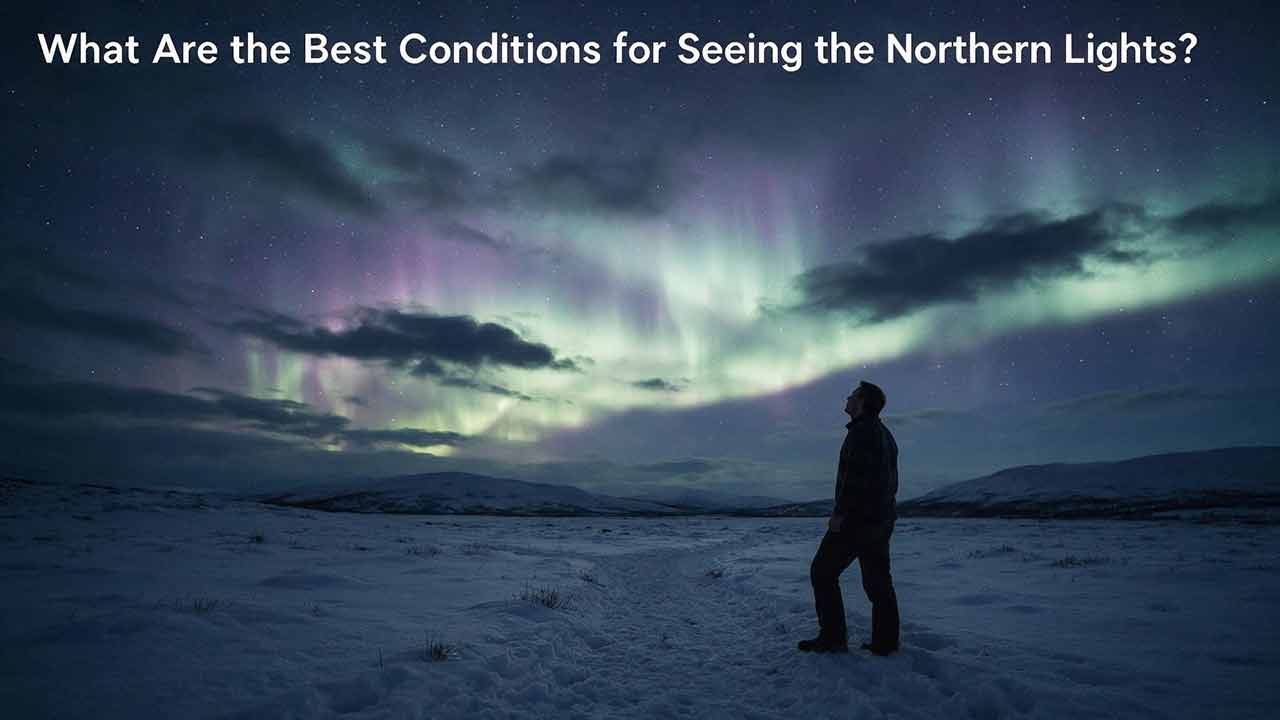
What Are the Best Conditions for Seeing the Northern Lights?
The best Northern Lights viewing conditions occur when geomagnetic activity, clear weather, darkness, and a suitable observing location align. This guide explains why the position of the auroral oval matters more than relying on a single Kp value and shows how cloud cover, twilight, light pollution, moonlight, atmospheric transparency, and horizon visibility affect what an observer can see. It introduces the Five-Gate Aurora Viewing Framework, a practical planning tool that evaluates aurora activity, clouds, darkness, location, and available viewing time without presenting the result as a guaranteed probability. Readers will also learn how to compare short- and long-range forecasts, convert UTC forecast periods, choose a safe dark-sky site, recognize faint aurora, and troubleshoot a promising forecast that produces no visible display. The article is based on guidance from NOAA, NASA, the University of Alaska Fairbanks, and the National Park Service.