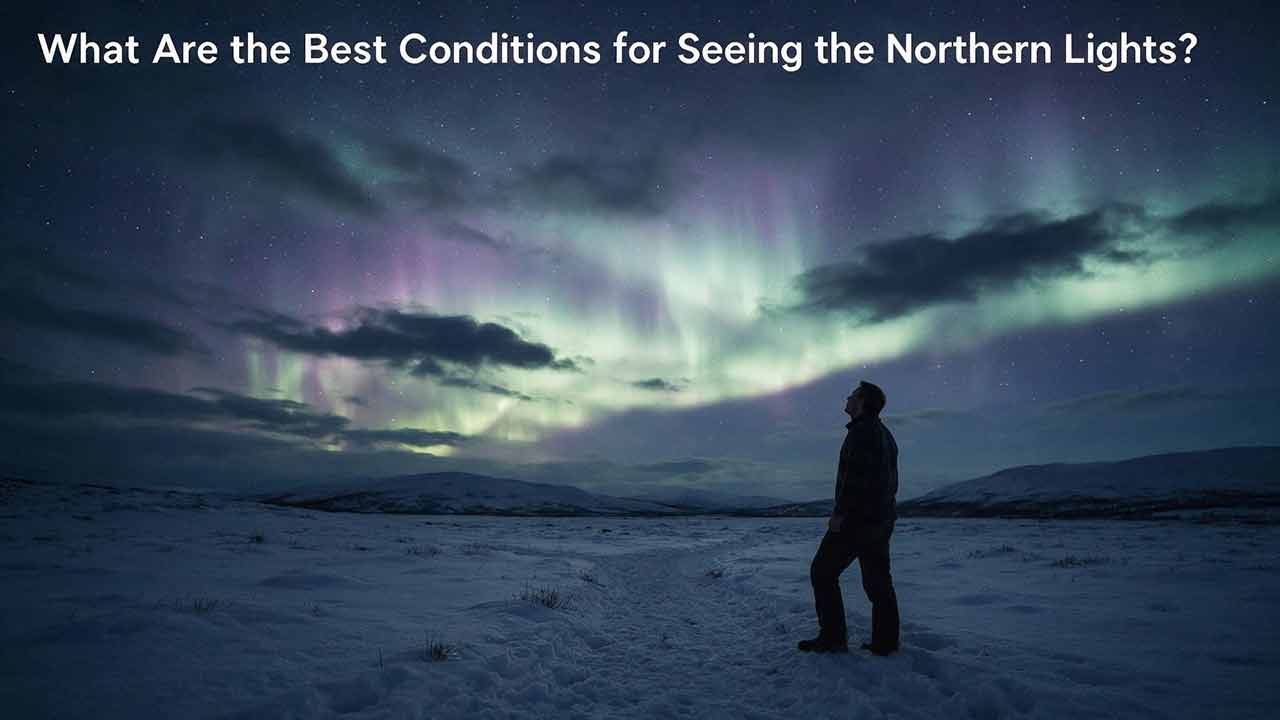
What Are the Best Conditions for Seeing the Northern Lights?

What Are the Best Conditions for Seeing the Northern Lights?
The best conditions for seeing the Northern Lights are a clear, sufficiently dark sky; an observing location near or under the auroral oval; geomagnetic activity strong enough for your latitude; little artificial light; an open view of the relevant horizon; and enough time to wait. No single Kp value, month, or forecast can guarantee a display.
Key Takeaways
- Clear skies and darkness are essential because clouds and daylight can hide an active aurora completely.
- Your position relative to the auroral oval matters more than any universal Kp threshold.
- A short-term auroral-oval forecast is usually more useful near departure time than a dramatic long-range headline.
- Light pollution, haze, moonlight, direct lighting, and blocked horizons affect how easily faint aurora can be recognized.
- The best decision combines space weather, local weather, darkness, location, and a flexible viewing window.
This guide will help you decide whether an aurora-viewing trip is worthwhile, choose a suitable observing site, interpret common forecast signals, and diagnose why the Northern Lights may remain invisible even when a forecast appears promising.
Should You Go Aurora Watching Tonight?
A viewing attempt is reasonable when all five statements below are true:
- The short-term auroral oval reaches or approaches your latitude.
- The part of the sky where the aurora is likely to appear will be mostly clear.
- The sky will become dark enough during the forecast window.
- You have a legal, safe, low-light viewing location with a useful horizon.
- You can remain outside long enough for conditions to change.
Do not go solely because a headline predicts a high Kp value. If daylight or widespread thick cloud covers the viewing window, stronger geomagnetic activity cannot make the aurora visible from the ground.
Which Conditions Matter Most for Northern Lights Viewing?
The most important conditions are auroral position, cloud cover, darkness, observing location, and timing. These conditions form a chain: one serious weakness can outweigh several favorable factors.
| Condition | Why it matters | Most favorable situation | Priority |
|---|---|---|---|
| Auroral oval position | Determines whether aurora is geographically reachable | Oval over your location or close enough to the relevant horizon | Essential |
| Cloud cover | Clouds lie below the aurora and can block it | Mostly clear sky in the expected viewing direction | Essential |
| Darkness | Daylight and bright twilight reduce contrast | Full darkness or the darkest locally available period | Essential |
| Local light pollution | Artificial light makes faint structures harder to see | Rural or dark suburban site without direct glare | High |
| Horizon visibility | Distant aurora may remain low in the sky | Open northern horizon when the oval is north of you | High |
| Geomagnetic activity | Stronger activity may brighten and expand the oval | Activity sufficient for your geomagnetic latitude | High |
| Viewing duration | Aurora can brighten, fade, and return | A flexible window of several hours | Moderate to high |
| Atmospheric transparency | Haze, smoke, moisture, and blowing snow reduce contrast | Dry, transparent air | Moderate |
| Moonlight | Bright moonlight can wash out faint displays | Moon below the horizon or away from the aurora | Secondary |
Moonlight is not usually a reason to cancel by itself. A strong display can remain visible under a bright Moon, while a faint display may become noticeably harder to recognize.
How Can You Evaluate the Conditions Without Relying on One Forecast Number?
Use the Five-Gate Aurora Viewing Framework.
The framework turns five practical questions into a repeatable decision:
- Activity Gate: Is the auroral oval expected to reach your latitude or viewing horizon?
- Cloud Gate: Will the relevant part of the sky be sufficiently clear?
- Darkness Gate: Will daylight and twilight be weak enough?
- Location Gate: Can you observe from a dark, legal, and safe site?
- Timing Gate: Can you remain outside through a useful forecast window?
How Does the Aurora Readiness Score Work?
Give each gate a score from 0 to 2.
| Gate | 0 points | 1 point | 2 points |
|---|---|---|---|
| Activity | Oval well away from your area | Marginal reach or substantial uncertainty | Oval over or close to your area |
| Cloud | Widespread cloud in the viewing direction | Broken, variable, or uncertain cloud | Mostly clear |
| Darkness | Daylight or bright twilight | Limited darkness or substantial skyglow | Fully or sufficiently dark |
| Location | Bright site or blocked horizon | Moderate light pollution or partial obstruction | Dark site with an open horizon |
| Timing | Only a brief glance is possible | One limited observing period | Flexible, extended viewing window |
A practical interpretation is:
- 8–10 points: Conditions justify a serious viewing attempt.
- 5–7 points: A display is possible, but one or more factors are marginal.
- 0–4 points: The outing has limited practical value unless conditions improve.
What Does the Score Actually Measure?
The Aurora Readiness Score ranks viewing readiness, not the probability of seeing aurora.
It is an original editorial tool built from publicly available variables used in aurora planning: oval position, cloud cover, darkness, location quality, and available observing time. It has not been validated as a scientific forecasting model.
A 10/10 night can remain quiet. A lower-scoring night can occasionally produce a brief display.
The score should therefore be used to:
- Compare possible viewing nights at the same destination
- Identify the weakest condition before leaving
- Decide whether changing time or location would improve the outing
- Prevent a high Kp forecast from overriding poor local conditions
Do not interpret the score as a success percentage or use it to compare unrelated locations as though they had identical geomagnetic geography.
When Should You Recheck the Five Gates?
Check the gates at three points:
- During initial planning: Compare possible dates using darkness, location, and longer-range forecasts.
- Before departure: Update cloud cover, short-term oval position, road conditions, and access.
- At the site: Recheck the sky, current forecast, horizon visibility, and recent observations.
The Activity and Cloud Gates can change quickly. The Darkness and Location Gates are usually easier to plan in advance.
What Are the Two Stop Rules?
Two conditions should not be overridden by a high total score:
- The sky will remain too bright during the entire activity window.
- Widespread thick cloud will block the relevant part of the sky.
Aurora occurs far above ordinary weather systems. An intense display can therefore be active while remaining completely hidden beneath overcast skies.
Which Secondary Conditions Modify Visibility?
Some factors affect contrast without deciding whether aurora is present. Treat these as Visibility Modifiers, not additional scoring gates.
| Visibility modifier | Likely effect |
|---|---|
| Bright Moon | Faint arcs and subtle colors may be harder to recognize |
| Heavy haze or smoke | Contrast may fall even when cloud cover appears low |
| Direct streetlights or headlights | Dark adaptation may be impaired |
| Excellent atmospheric transparency | Weak structures may become easier to detect |
| Fresh snow near artificial lighting | Reflected light may brighten the foreground and sky |
| Camera night mode | Faint color may be recorded before it is obvious to the eye |
| Strong wind or severe cold | The observer may be unable to remain outside long enough |
These modifiers help explain why two observers under similar geomagnetic conditions can report different experiences.
How Much Geomagnetic Activity Do You Need?
You need enough geomagnetic activity for the auroral oval to reach your location or become visible above your horizon. The required activity depends heavily on geomagnetic latitude.
The auroral oval is the ring-shaped region around a geomagnetic pole where aurora is most likely to occur. It expands, contracts, brightens, and shifts as space-weather conditions change.
The Kp index is a global measure of geomagnetic activity on a scale from 0 to 9. Higher Kp values generally correspond to stronger disturbances and a greater possibility of aurora farther from the poles.
However, NASA describes Kp as a rough intensity guide rather than a precise real-time timing tool. A Kp value does not tell you whether your local sky is clear, whether darkness has arrived, or whether the brightest part of the oval is positioned favorably for your location.
See NASA’s Guide to Finding and Photographing Auroras for NASA’s explanation of Kp and practical observing conditions.
| Observer position | What matters most | Practical interpretation |
|---|---|---|
| Under the usual auroral oval | Cloud cover and darkness | Aurora may appear during relatively modest activity |
| Near the oval’s typical southern edge | Short-term oval movement | A moderate expansion may bring aurora into view |
| Well south of the normal oval | Substantial geomagnetic disturbance | Stronger expansion is usually required |
| Farther south during a major event | Verified current activity and an open horizon | Aurora may first appear faint, low, red, or camera-visible |
This is why statements such as “Kp 5 is always enough” are misleading. The same Kp value can produce very different viewing outcomes in Alaska, Scotland, Minnesota, Germany, or the central United States.
Which Aurora Forecast Is Most Useful?
No single forecast is best at every planning stage.
Several Weeks Before the Trip
Use long-range products only to identify possible periods of interest. Solar rotation can create recurring patterns, but long-range forecasts contain substantial uncertainty and should not determine expensive travel decisions by themselves.
The University of Alaska Fairbanks Aurora Forecast explicitly distinguishes its more reliable three-day forecast from its less reliable 27-day outlook.
One to Three Days Before Viewing
Use an official geomagnetic forecast, such as the NOAA Space Weather Prediction Center three-day forecast, together with a local hourly weather forecast.
Forecast Kp values are normally presented in UTC intervals. Convert them carefully into local time and verify whether the interval falls before or after local midnight.
Shortly Before Departure
Check the NOAA Aurora 30-Minute Forecast.
NOAA states that this OVATION-based product typically provides a forecast about 30–90 minutes ahead. The lead time is based on how long measured solar wind takes to travel from the L1 observation point to Earth, so it varies with solar-wind speed and available input data.
If normal solar-wind inputs are unavailable and substitute data are used, the effective lead time may be reduced. Treat the product as short-term guidance rather than a guaranteed schedule.
After You Arrive
Continue checking:
- The latest auroral-oval position
- Current geomagnetic observations
- Changes in local cloud cover
- Credible nearby sighting reports
- Whether stars and clear gaps are appearing in the viewing direction
Forecasts can improve or weaken after you leave home.
Why Are Clear Skies So Important?
Aurora forms high above the weather, but an observer must look through the lower atmosphere to see it. Clouds, fog, smoke, blowing snow, and thick haze can reduce or eliminate visibility.
Cloud direction matters as much as a regional cloud percentage.
| Sky condition | Practical interpretation |
|---|---|
| Clear or mostly clear | Best option |
| Broken cloud with moving gaps | Worth considering when activity is favorable |
| Cloudy overhead but clear to the north | Low northern aurora may still be visible |
| Clear overhead but cloudy northern horizon | Poor when the oval remains north of you |
| Widespread overcast | Very low chance from that location |
| Fog or low stratus | Often more obstructive than a general forecast suggests |
| Thin high cloud | Bright aurora may remain visible, but faint detail can be lost |
A single weather-app icon may hide important hourly changes. Compare the expected cloud cover at your current location with one or two safely reachable alternatives.
Can Stars Help You Judge Transparency?
Stars provide a useful field check, but the test must be interpreted carefully.
If stars that should normally be visible under the local moonlight and artificial-light conditions are missing in the viewing direction, cloud, fog, smoke, haze, poor transparency, or nearby glare may also be reducing aurora visibility.
Not seeing stars does not always prove that thick cloud is present. Bright moonlight, city glow, direct lighting, limited dark adaptation, and individual eyesight can also affect the result.
How Dark Does the Sky Need to Be?
Faint aurora is easiest to see under a fully dark sky. Astronomical darkness provides excellent contrast, but it is not an absolute requirement for every display.
A sufficiently bright aurora may become visible during darker stages of twilight. NOAA notes that aurora can sometimes be observed shortly after sunset or before sunrise when the sky at the observing location is dark enough.
For practical planning:
- Check sunset, civil twilight, nautical twilight, and astronomical twilight.
- Identify the darkest part of the night.
- Compare that period with the expected activity window.
- Do not assume that a fixed clock time will be equally dark at every latitude or season.
At high northern latitudes, aurora can occur during summer but remain invisible because the Sun does not descend far enough below the horizon.
The National Park Service’s Denali aurora guidance explains how seasonal daylight can eliminate useful viewing conditions even when auroral activity is present.
Does a Full Moon Ruin Northern Lights Viewing?
No. Moonlight does not stop aurora from forming, and a bright display can remain clearly visible during a full Moon.
The main tradeoff is contrast. Strong moonlight may wash out:
- Faint arcs
- Subtle red emissions
- Weak vertical rays
- Low-contrast movement
- Dim structure close to the horizon
Moonlight can also illuminate snow, mountains, trees, and foreground scenery. This may help with safe movement and landscape photography.
For a marginal forecast, darker lunar conditions are helpful. For a strong forecast, cloud cover, oval position, direct lighting, and local skyglow are usually more important.
Where Should You Go to See the Northern Lights?
Choose the darkest safe location you can reach without creating unnecessary travel risk.
A strong viewing site has:
- Legal nighttime access
- Safe parking away from active traffic
- Little or no direct artificial lighting
- An open view toward the north
- Minimal city glow in the viewing direction
- Firm, known ground
- A safe return route
- Weather and road conditions appropriate for your vehicle and experience
When activity is weak or the oval remains north of your location, the northern horizon is especially important. Trees, buildings, hills, or mountains may hide a distant arc.
During stronger activity, aurora can expand overhead and appear in other parts of the sky. Scan the whole sky rather than facing north continuously.
| Location type | Advantages | Limitations | Best suited to |
|---|---|---|---|
| City center | Convenient and accessible | Severe skyglow and direct lighting | Very bright displays |
| Dark suburban edge | Short travel time | Some horizon glow remains | Moderate or strong activity |
| Rural public area | Better contrast and horizon options | Longer drive and fewer facilities | Most viewing attempts |
| High-latitude town | Frequent proximity to the oval | Local weather and streetlights still matter | Routine aurora watching |
| Elevated viewpoint | Potentially open horizon | Wind, ice, cloud, and road restrictions | Safe, accessible terrain only |
| Remote wilderness | Very dark skies | Greater navigation, cold, wildlife, and access risks | Prepared observers with local knowledge |
The most remote site is not automatically the best site. A familiar public location with safe parking and a clear horizon is often more useful than an isolated road, frozen lake, mountain route, or private property.
When Is the Best Time of Night to Look?
The hours around local midnight are statistically favorable, but aurora can appear at any time during darkness.
NASA advises looking around midnight while noting that strong solar activity can produce aurora at any point between sunset and sunrise. See How Can I See the Northern Lights? We Asked a NASA Expert.
Midnight is therefore a useful planning center, not an appointment.
A practical observing window often works better than a single target time:
- Arrive before the most promising forecast interval.
- Allow your eyes to adapt.
- Stay through temporary quiet periods.
- Recheck the sky after cloud gaps develop.
- Continue beyond midnight when conditions remain favorable.
Which Months Offer the Best Conditions?
Aurora occurs throughout the year, but ground-based observers need darkness. At northern destinations, autumn through early spring usually provides the most useful overlap between darkness and accessible nighttime conditions.
NASA identifies March and September as statistically favorable months, but this does not make them universally best for every destination. Local cloud patterns, twilight, road conditions, temperature, and the number of available nights can matter more than the calendar month.
| Period | Main advantage | Main limitation |
|---|---|---|
| Early autumn | Returning darkness and relatively mild temperatures | Twilight may still shorten the viewing window |
| Late autumn | Longer nights | Stormy or cloudy weather in some regions |
| Midwinter | Maximum darkness | Extreme cold, ice, snow, and difficult roads |
| Early spring | Useful darkness with improving daytime travel | Nights shorten steadily |
| Late spring and summer | Milder weather | Insufficient darkness at many high-latitude locations |
For a dedicated aurora trip, several nights at one destination are usually more valuable than choosing one supposedly perfect date months in advance.
How Should You Plan an Aurora-Viewing Night?
Step 1: Confirm That Darkness Will Overlap the Forecast
Check local twilight times, not only sunset. At high latitudes, verify that the sky becomes sufficiently dark during the expected activity period.
Step 2: Review Hourly Cloud Cover
Look at cloud cover, fog, precipitation, visibility, and wind. Pay particular attention to the northern horizon when the oval is expected to remain north of you.
Step 3: Check the Multi-Day Space-Weather Outlook
Use NOAA or UAF to identify whether geomagnetic activity may become favorable. Treat longer-range information as planning guidance, not a promise.
Step 4: Convert UTC Correctly
Write down the forecast interval in local time. Check whether the conversion changes the date and whether daylight-saving time applies.
Step 5: Inspect the Short-Term Auroral Oval
Before departure, compare the NOAA OVATION oval with your location. Determine whether the aurora is expected overhead, close to the horizon, or still too far away.
Step 6: Choose a Safe Viewing Site
Confirm legal access, parking, road conditions, horizon visibility, and a safe route home. Do not rely on an unfamiliar remote location merely because it appears dark on a map.
Step 7: Arrive Early and Protect Dark Adaptation
Reduce screen brightness and avoid direct white light. The National Park Service advises allowing approximately 30 minutes for stronger dark adaptation when observing faint night-sky features.
See Aurora Borealis and the Night Sky in Denali.
Step 8: Scan for Structure, Not Just Color
Faint aurora may look gray-white rather than bright green. Watch for:
- A smooth arc that remains separate from clouds
- Vertical rays
- Curtains or folds
- Gradual movement
- Repeated brightening
- Shapes that change independently of the landscape
Step 9: Use a Camera as a Secondary Check
A smartphone night mode or camera exposure may reveal green or red light before the color is obvious to the eye. NASA notes that modern digital sensors can record aurora too faint for unaided vision.
A camera result should not be presented as though it matches the naked-eye view. Long exposures collect light over time and often show more color and brightness.
Step 10: Remain Patient
Aurora can fade, return, move, or intensify with little warning. A quiet sky during the first ten minutes does not determine what will happen during the rest of the night.
How Does the Framework Work in a Realistic Scenario?
The following is an illustrative scenario, not a record of a specific historical forecast or confirmed sighting.
An observer in northern Minnesota sees that the short-term auroral oval is approaching the northern United States. Local conditions are:
- Mostly clear skies after 10:30 p.m.
- Full darkness during the expected activity window
- A rural public site with a clear northern horizon
- Moderate moonlight
- At least two hours available for observing
The score would be:
| Gate | Score | Reason |
|---|---|---|
| Activity | 2 | The oval is close enough to create a plausible opportunity |
| Cloud | 2 | The relevant sky is expected to remain mostly clear |
| Darkness | 2 | Full darkness overlaps the viewing window |
| Location | 2 | The site is dark and has an open northern horizon |
| Timing | 2 | The observer can remain for an extended period |
| Total | 10/10 | Strong viewing readiness, but no guarantee |
Moonlight acts as a Visibility Modifier. It may make a weak display harder to see, but it does not cancel the outing.
Now change one condition: widespread low cloud arrives before departure. The Cloud Gate falls to zero and triggers a stop rule.
The geomagnetic forecast may still be favorable, but the local viewing opportunity is no longer strong because the aurora would be hidden.
What Are the Most Common Aurora-Viewing Mistakes?
Treating Kp as a Guarantee
Kp summarizes broad geomagnetic activity. It does not guarantee that the oval will be favorably positioned above your exact location.
Better approach: Use Kp for context, then inspect the short-term oval and local conditions.
Checking Only a Daily Weather Icon
A partly cloudy symbol may hide large hourly differences or cloud concentrated along the northern horizon.
Better approach: Compare hourly forecasts and inspect the direction of the expected cloud.
Ignoring UTC
A forecast interval can move into a different local evening or calendar date after conversion.
Better approach: Convert every relevant forecast period before making travel plans.
Leaving After a Few Quiet Minutes
Aurora intensity changes over time. A faint arc may brighten suddenly or return after a quiet interval.
Better approach: Allow a longer observing window when weather and safety permit.
Standing Beside Direct Lighting
A single streetlamp, headlight, or bright phone screen can reduce sensitivity to faint structures.
Better approach: Block direct light and give your eyes time to readapt.
Expecting Photograph-Level Color
A camera may show saturated green or red while the eye sees pale green, gray, or white.
Better approach: Look for movement, shape, rays, and changing structure rather than color alone.
Confusing Artificial Light With Aurora
Clouds above a town may reflect orange, yellow, or white light and create a stationary glow.
Better approach: Change position, compare the glow with the city’s location, check whether stars remain visible, and take a short test image.
Why Can’t You See the Aurora Even When the Forecast Looks Good?
| Symptom | Likely explanation | Practical response |
|---|---|---|
| No stars are visible | Cloud, fog, smoke, haze, glare, or poor dark adaptation | Check nearby conditions and reduce direct lighting |
| Stars are visible but no aurora appears | Oval may remain too far away or activity may have weakened | Recheck the short-term oval and current observations |
| Camera shows green but the eye sees gray | The display is faint and the camera is more sensitive | Dark-adapt and watch for movement |
| A glow stays fixed over a city | Artificial light is reflecting from haze or cloud | Reposition away from the city glow |
| The forecast was stronger earlier | Activity peaked before darkness or the forecast changed | Use current data rather than an earlier headline |
| Aurora remains close to the horizon | The oval is still north of the observer | Find a safely accessible open horizon |
| Clouds clear after the predicted peak | Weather and activity did not overlap | Continue checking current conditions |
| The display fades suddenly | Natural short-term variability | Wait and scan the sky again |
| Colors look weaker than photographs | Human low-light color vision is limited | Set realistic naked-eye expectations |
What Should You Bring?
Use this checklist before leaving:
- Local twilight times confirmed
- Hourly cloud conditions checked
- NOAA short-term oval reviewed
- Forecast intervals converted from UTC
- Legal viewing site selected
- Horizon direction checked
- Road and weather conditions reviewed
- Warm layers suitable for the forecast
- Charged phone and backup battery
- Offline map or known return route
- Dim or red light available
- Tripod packed if photographing
- Emergency supplies appropriate for the location
- Someone informed of the destination when traveling remotely
- No plan to stop on an active road shoulder
- No plan to enter closed, private, unstable, or unfamiliar terrain
Aurora viewing is generally a low-risk activity when conducted from a safe public site. Cold exposure, poor roads, darkness, traffic, unstable ice, and unfamiliar terrain usually present greater practical risks than the aurora itself.
Which Strategy Is Best for Different Observers?
High-Latitude Residents
Prioritize cloud cover, darkness, and convenience. Because the oval may already be nearby, waiting for an unusually high Kp value can cause you to miss displays during quieter conditions.
Lower-Latitude Observers
Wait for credible evidence that the oval is expanding toward your area. Choose a dark location with a clear northern horizon and check current reports before making a long drive.
Aurora Travelers
Allow several nights whenever possible. Multiple nights reduce the chance that one period of cloud or mistimed activity will determine the entire trip.
Casual Observers
Use the Five-Gate Framework and choose a familiar, safe site. A nearby clear location often provides more value than a famous distant viewpoint under poor weather.
Photographers
Consider Moon position, foreground lighting, wind, condensation, battery performance, and tripod stability. Do not describe long-exposure photographs as exact reproductions of naked-eye visibility.
What Does This Guide Claim—and Not Claim?
This guide explains practical conditions that affect aurora visibility and presents an original editorial framework for comparing viewing opportunities.
It does not:
- Guarantee a Northern Lights sighting
- Predict exact local brightness
- Convert the readiness score into a success probability
- Replace official weather, road, emergency, or space-weather information
- Claim that every person will perceive the same colors
- Claim that a camera image represents the unaided-eye view
- Claim that one observation validates the scoring framework
Aurora forecasting remains uncertain because solar-wind conditions, magnetic orientation, auroral-oval position, local weather, atmospheric transparency, and human perception can all change.
What Is the Practical Conclusion?
The best conditions for seeing the Northern Lights occur when five factors overlap: the auroral oval reaches your area, the relevant sky remains clear, darkness overlaps the activity window, your observing location has little artificial light and a useful horizon, and you have enough time to wait.
For a high-latitude observer, the next step is usually to check cloud cover and darkness. For a lower-latitude observer, the next step is to confirm that the oval is expanding far enough south. For a traveler, the strongest strategy is to preserve several possible viewing nights rather than depending on one forecast.
Frequently Asked Questions
Can You See the Northern Lights During a Full Moon?
Yes. A bright aurora can remain visible during a full Moon. Moonlight mainly reduces contrast, making faint arcs, subtle colors, and weak structures harder to recognize.
Is Kp 5 Enough to See the Northern Lights?
It depends on your geomagnetic latitude and the auroral oval’s position. Kp 5 may produce a useful opportunity at one location while leaving another location too far from the oval. Check the short-term oval and local conditions rather than relying on Kp alone.
Can Thin Clouds Hide the Aurora?
Thin cloud may weaken or blur aurora without hiding it completely. Thick cloud, fog, or low stratus can block it. Bright aurora may remain visible through small gaps, while a faint display may disappear behind very thin cloud.
Do You Need Complete Astronomical Darkness?
No. Astronomical darkness provides the best contrast for faint displays, but a bright aurora may become visible during darker twilight. The important question is whether the sky is dark enough for the expected brightness of the display.
What Is the Best Time of Night to Look?
The hours around local midnight are often favorable, but aurora can appear at any point during darkness. Convert forecast times from UTC correctly and use a flexible viewing window rather than a single target minute.
Can a Phone See Aurora That Your Eyes Cannot?
Yes. Modern phone cameras can collect more light and detect faint color that is difficult to perceive with the unaided eye. A night-mode image can help confirm weak aurora, but it may look brighter and more colorful than the live view.
Sources and Editorial Approach
This article was prepared by comparing current first-party guidance from NOAA, NASA, the University of Alaska Fairbanks Geophysical Institute, and the U.S. National Park Service.
Official sources support the scientific and operational information about:
- Kp and geomagnetic activity
- Auroral-oval forecasts
- Short-term OVATION lead times
- Seasonal darkness
- Typical viewing times
- Dark adaptation
- Camera sensitivity
- Safe, dark observing locations
The Five-Gate Aurora Viewing Framework, Aurora Readiness Score, stop rules, Visibility Modifiers, and illustrative Minnesota scenario are original editorial tools. They organize public forecast variables into a practical decision process and are not official NOAA, NASA, UAF, or NPS products.
Sources accessed August 3, 2026:
- NOAA Space Weather Prediction Center — Aurora 30-Minute Forecast
- NOAA Space Weather Prediction Center — 3-Day Forecast
- NASA Science — NASA’s Guide to Finding and Photographing Auroras
- NASA — How Can I See the Northern Lights? We Asked a NASA Expert
- NASA Science — Auroras
- University of Alaska Fairbanks Geophysical Institute — Aurora Forecast
- University of Alaska Fairbanks Geophysical Institute — Aurora Forecast
- National Park Service — Aurora Borealis and Stargazing in Denali
- National Park Service — Aurora Borealis and the Night Sky
Editorial Notes
Editorial review: Checked against the NOAA, NASA, UAF, and National Park Service sources cited above.
Independent scientific review: This page does not claim independent review by a space-weather scientist.
More from Aurora Forecasting & Viewing
How to Photograph the Northern Lights
Photographing the Northern Lights requires more than choosing one fixed camera setting. This practical guide explains how to select a camera and lens, focus accurately on stars, stabilize your equipment, and adjust shutter speed, aperture, and ISO according to the aurora’s brightness and movement. It includes starting settings for fast, moderate, and faint displays, along with a Motion–Brightness–Foreground framework that helps photographers make better decisions as conditions change. Readers will also learn how to use a smartphone Night mode, compose a stronger foreground, protect color-channel highlights, edit images responsibly, and disclose exposure blends clearly. A quick-reference card, three-frame comparison method, packing checklist, safety guidance, and detailed troubleshooting table make the article useful in the field. The guide relies on published guidance from NASA, NOAA, Nikon, Canon, and Apple while clearly distinguishing authoritative information from adjustable photography recommendations.
How Far South Can the Northern Lights Be Seen?
The northern lights usually remain within high-latitude regions, but powerful geomagnetic storms can carry visible aurora surprisingly far south. This guide explains why there is no single worldwide southern boundary and shows how geomagnetic latitude, the auroral oval, Kp, storm intensity, emission altitude, darkness, cloud cover, and local light pollution affect what an observer may see. It examines NOAA’s generalized U.S. visibility examples for G1 through G5 storms, while clarifying that locations such as Alabama, Florida, and southern Texas represent rare historical possibilities rather than guaranteed forecast limits. Readers will also find an original four-gate decision framework, an auditable geometric viewing-distance example, regional viewing guidance, a practical checklist, and troubleshooting advice for distinguishing faint aurora from clouds or artificial sky glow. The article helps observers decide when a forecast justifies going outside or traveling to a safer, darker viewing site.
What Does the Kp Index Mean for Aurora Viewing?
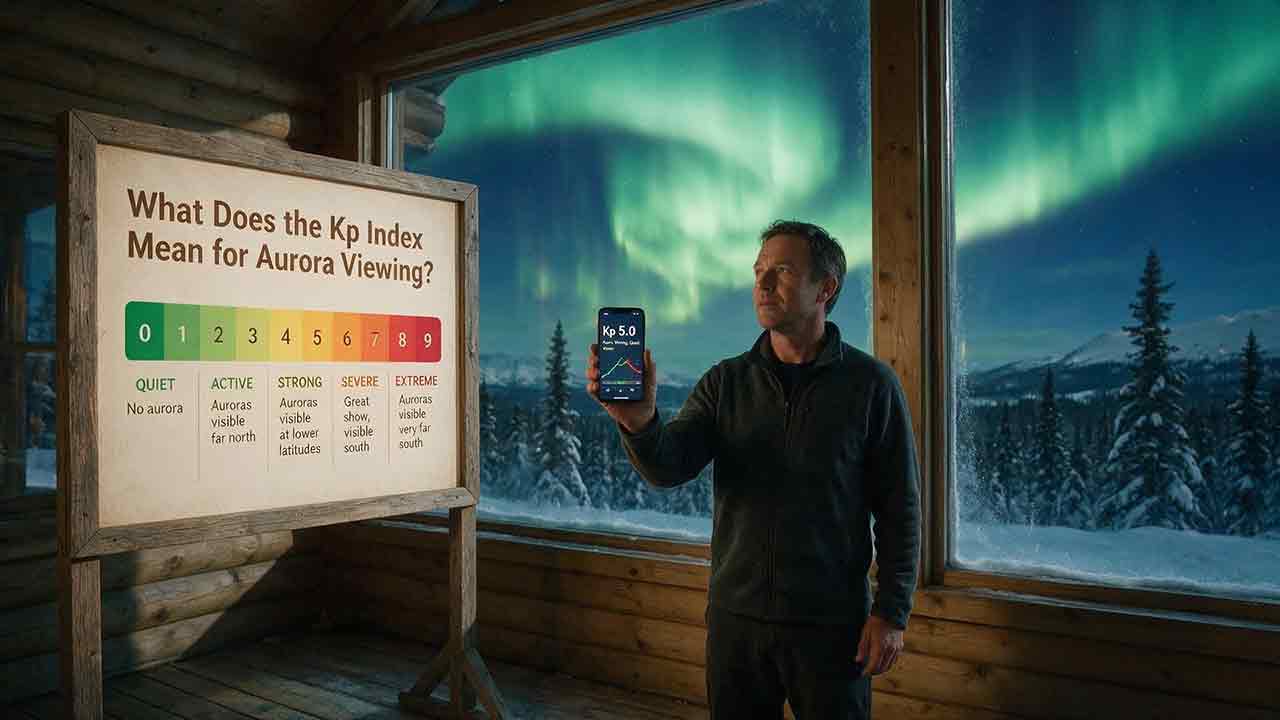
The Kp index measures global geomagnetic activity on a scale from 0 to 9, but it is not a local aurora brightness score. This practical guide explains what different Kp levels mean, how NOAA’s G1–G5 storm categories relate to Kp, and why magnetic latitude, the auroral oval, cloud cover, darkness, and timing still determine whether the northern or southern lights are visible. Readers will learn how to interpret three-hour UTC forecasts, understand decimal and traditional Kp notation, and avoid common mistakes such as waiting for Kp 5 inside the normal auroral zone. The article also introduces the original Reach–Timing–Sky–Signal framework, a viewing decision matrix, troubleshooting guidance, and a pre-departure checklist. Using authoritative NOAA and GFZ documentation, it turns a global space-weather measurement into a realistic decision tool for travelers, photographers, high-latitude residents, and middle-latitude aurora watchers.
Explore More Topics
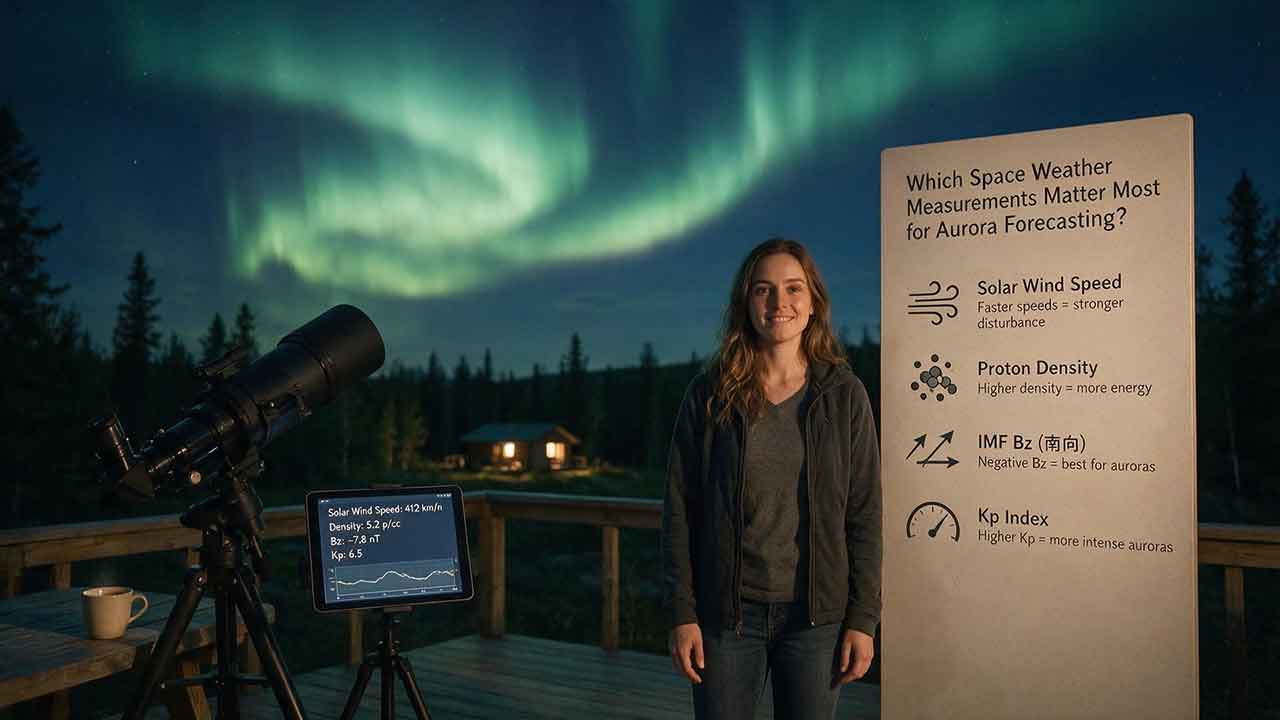
Which Space Weather Measurements Matter Most for Aurora Forecasting?
Aurora forecasting becomes more reliable when each space weather measurement is used for the right decision window. This guide explains why CME direction and propagation models matter several days ahead, while sustained southward Bz, total magnetic-field strength, solar-wind speed, density, and dynamic pressure become more useful as a disturbance approaches Earth. It also shows how Kp, auroral-oval maps, hemispheric power, AE, Dst, and local magnetometers answer different forecasting questions. Readers will learn a practical Signal–Coupling–Response–Visibility framework, compare upstream warning time with NOAA’s auroral-model guidance, work through a dynamic-pressure example, and troubleshoot conflicting forecast signals. The article also explains commonly overvalued indicators, including flare class, isolated Bz spikes, and Kp values without local-time context. Designed for aurora viewers, photographers, and travelers, it provides a clear checklist for combining official space weather data with darkness, cloud cover, road safety, and horizon visibility—without promising that any single measurement can guarantee a visible display.
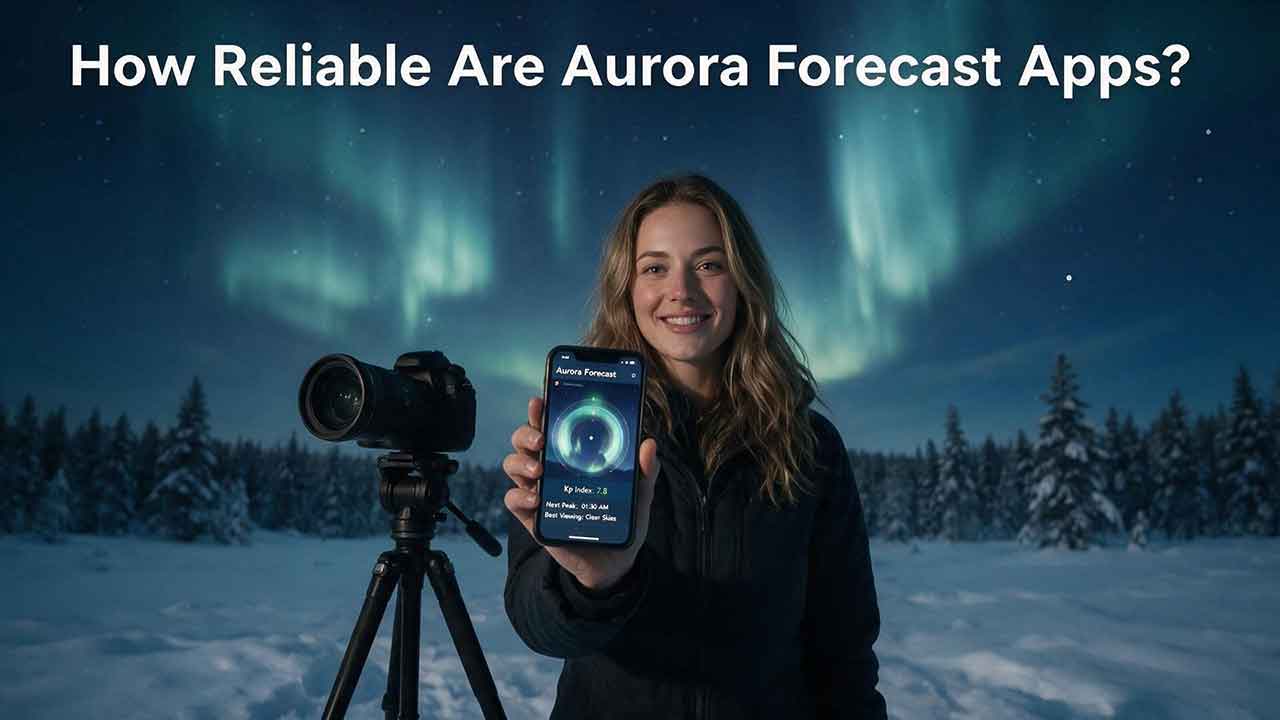
How Reliable Are Aurora Forecast Apps?
Aurora forecast apps are useful for identifying periods of elevated geomagnetic activity, but they cannot guarantee that the northern lights will be visible from a specific location at a specific time. This guide explains why app alerts sometimes disagree, how forecast reliability changes as an event approaches, and which measurements deserve the most attention. Readers will learn how to interpret the auroral oval, observed and forecast Kp, solar-wind speed, Bz, cloud cover, darkness, timestamps, and official space-weather alerts. The article also introduces the Signal-to-Sky Reliability Framework, a viewing-location comparison tool, and a transparent method for auditing app notifications without inventing accuracy claims. Practical tables, troubleshooting guidance, and a step-by-step verification process help casual observers, photographers, travelers, and lower-latitude aurora chasers decide when an alert is worth acting on. The guide is based on authoritative documentation and published research rather than hands-on commercial app rankings.
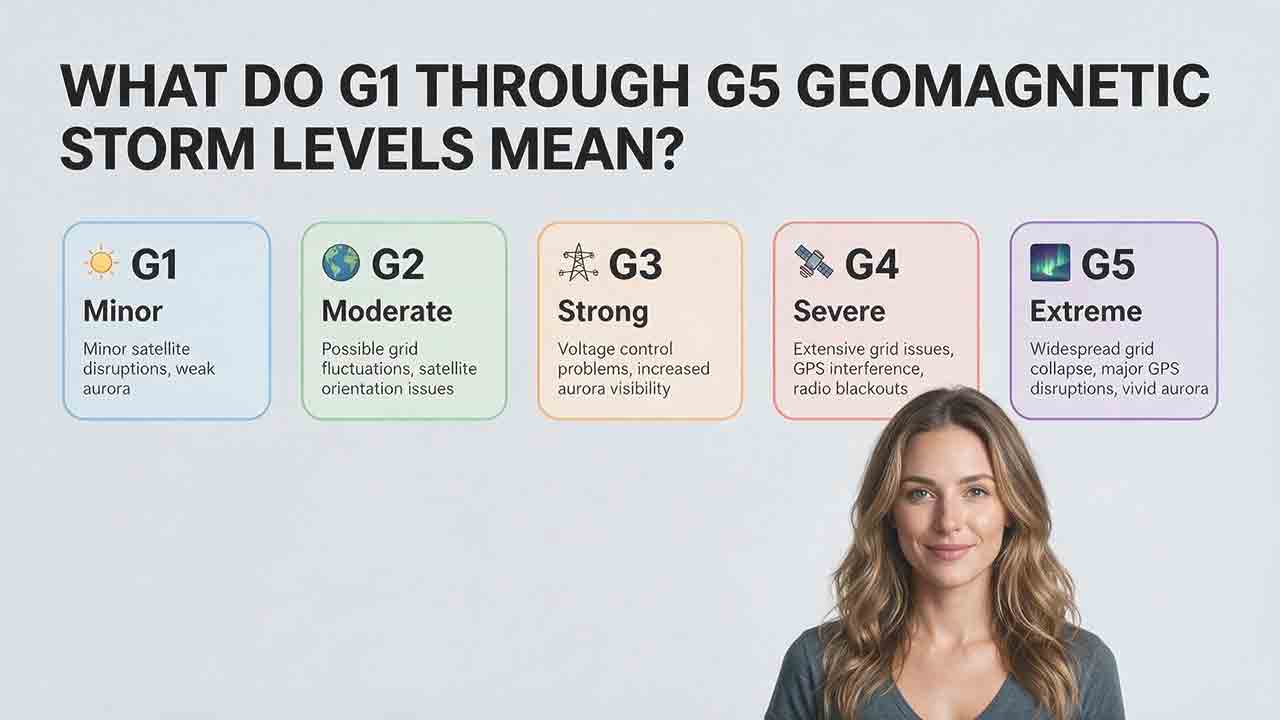
What Do G1 Through G5 Geomagnetic Storm Levels Mean?
NOAA’s G1 through G5 scale ranks geomagnetic storms from minor to extreme and translates planetary Kp measurements into practical impact categories. This guide explains the exact relationship between G levels and Kp notation, including why Kp 9− remains G4 while only Kp 9o qualifies as G5. It compares the possible effects of each level on aurora visibility, power systems, satellites, high-frequency radio, GPS, and precision navigation without treating those outcomes as guaranteed. Readers also learn how to distinguish a forecast, watch, warning, and observed alert; convert UTC forecast windows; interpret decimal Kp values such as 4.67 and 8.67; and apply the Scale–Status–Window–Location–System framework. Practical tables, a G3 watch example, common mistakes, and user-specific recommendations help the public, aurora observers, and technical users respond appropriately without unnecessary alarm.